
The video lesson for this topic is coming soon.
Essential Question
What happens when parts of a circuit share one path?
Real circuits have more than one part. When the parts are connected one after another in a single loop, they form a series circuit. By the end of this lesson, you should be able to find the total resistance, the current, and the voltage across each part of a series circuit.
One Path
- Parts connected end to end
- Charge has only one path
- It flows through every part
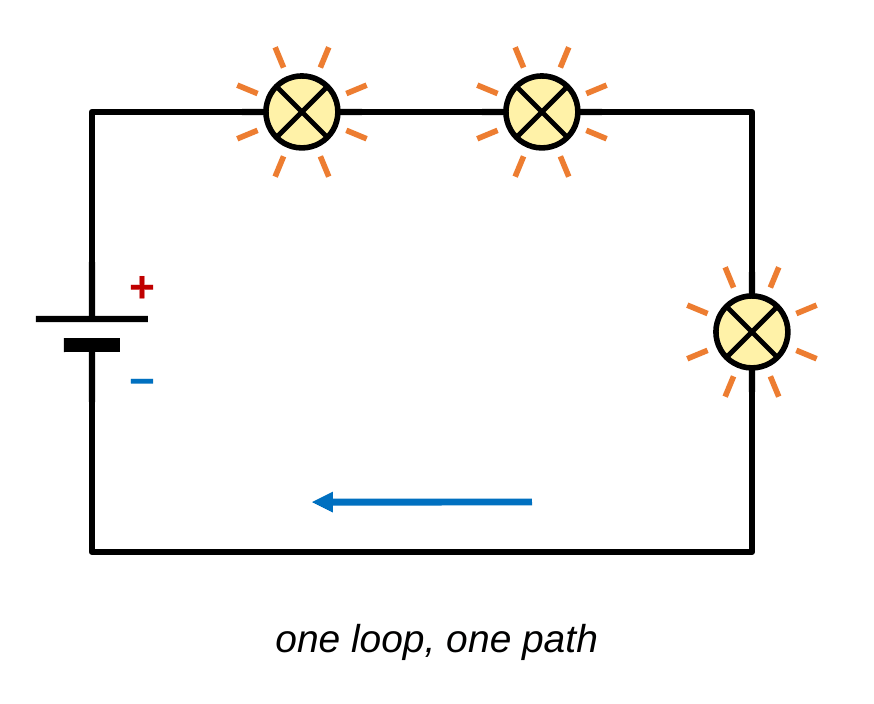
In a series circuit, the parts are connected end to end in a single loop. Charge leaving the battery has only one path to follow, so it must pass through every part, one after another, before it returns to the battery.
Same Current Everywhere
- Same current at every point
- Charge is not used up
- I = I1 = I2
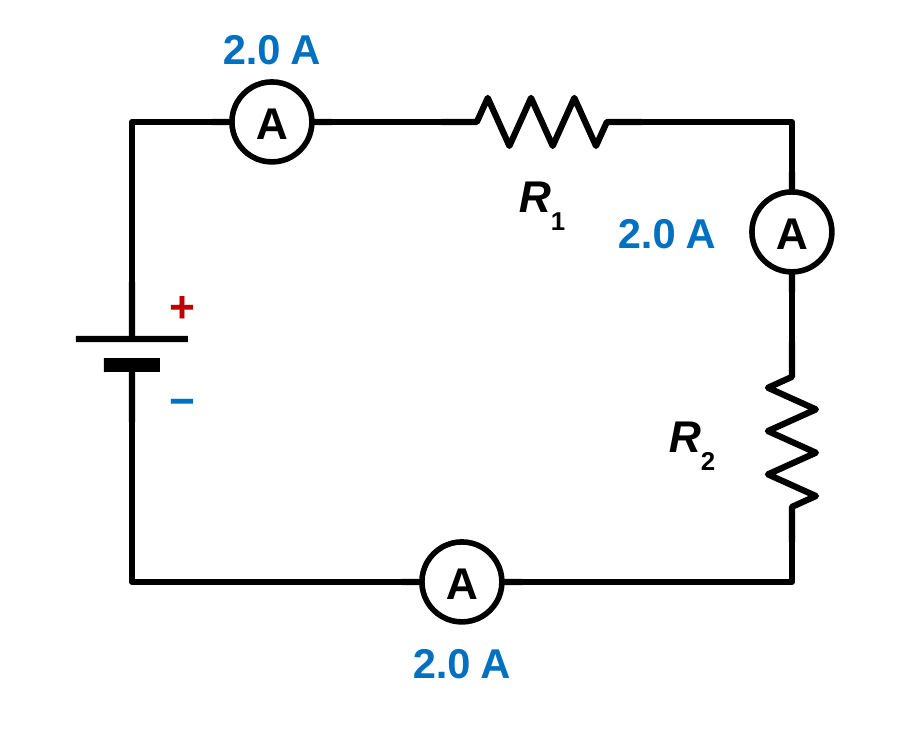
Because there is only one path, every coulomb that leaves the battery passes through every part. Charge is not used up along the way, so the current is the same everywhere in a series circuit. An ammeter placed anywhere in the loop gives the same reading.
Voltages Add Up
- Each part uses some voltage
- Drops add to the battery voltage
- V = V1 + V2 + …
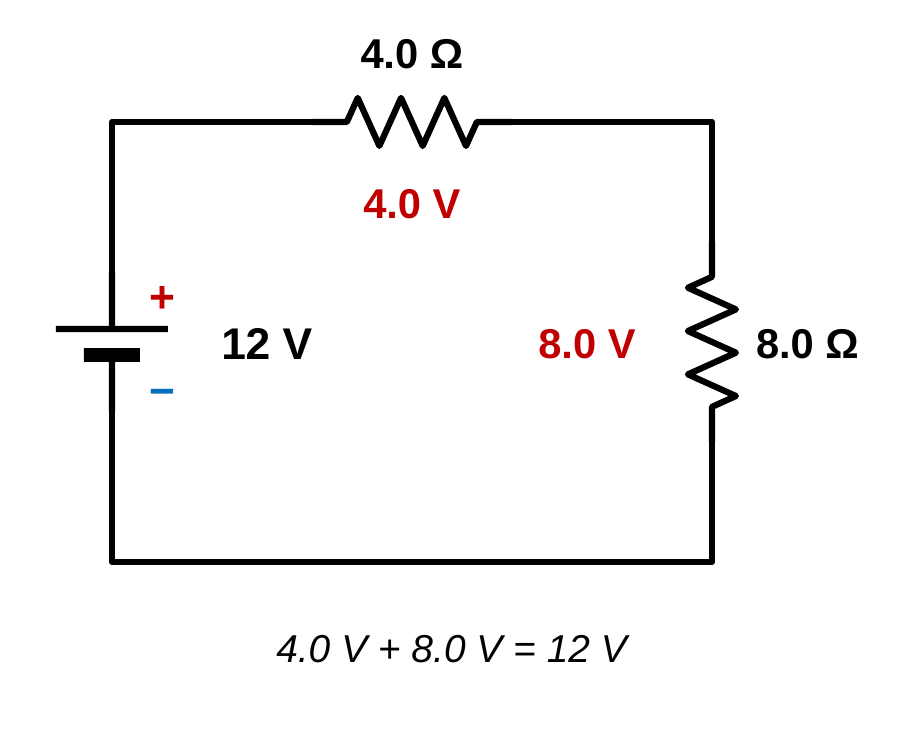
The battery gives each coulomb a certain amount of energy (12 J per coulomb for a 12 V battery). As the charge travels around the loop, it gives that energy away to the parts it passes through. By the time it returns to the battery, all of it has been used, so the voltage drops across the parts add up to the battery voltage. This is conservation of energy. The bigger resistor gets the bigger share: here the 8.0 Ω resistor drops 8.0 V and the 4.0 Ω resistor drops 4.0 V.
Total Resistance
- Resistances in series add
- RT = R1 + R2 + …
- More resistors, less current
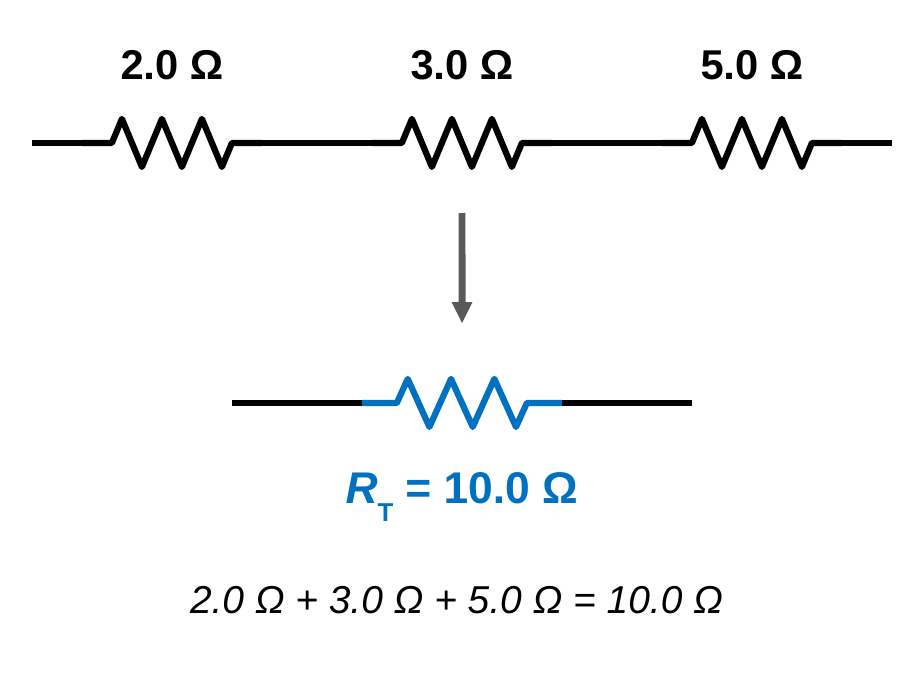
In series, the charge has to push through every resistor, one after another, so the resistances simply add: RT = R1 + R2 + R3 + …. Three resistors of 2.0 Ω, 3.0 Ω, and 5.0 Ω act like one 10.0 Ω resistor. Adding another resistor in series always increases the total resistance, which decreases the current from the battery.
One Bulb Out, All Out
- A break anywhere opens the loop
- Current stops everywhere
- Every bulb goes dark
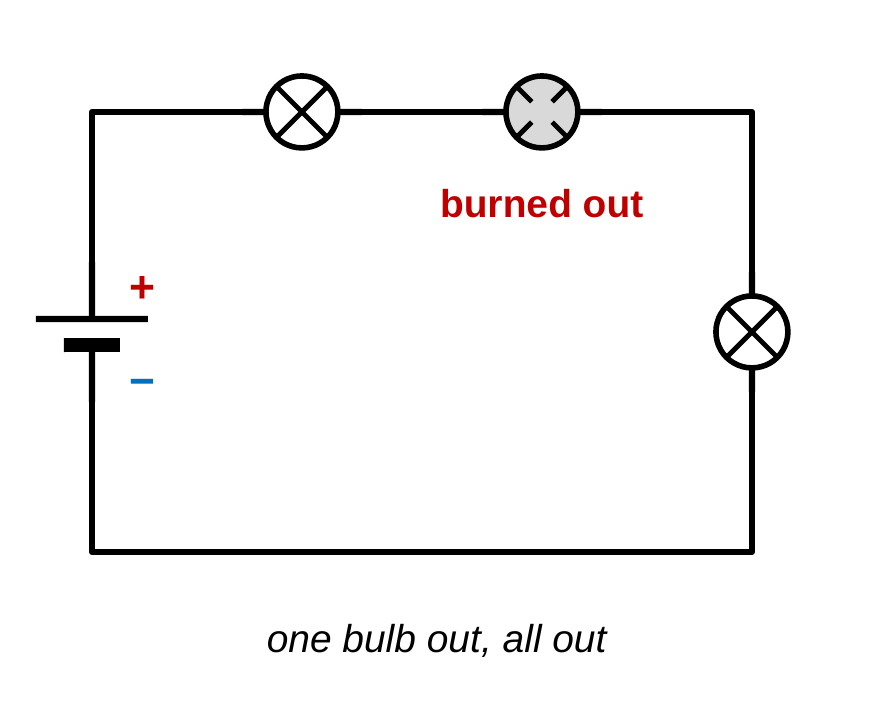
When a bulb burns out, its filament breaks and leaves a gap. In a series circuit that gap opens the only loop, so the current stops everywhere and every bulb goes dark, even the ones that still work. Old strings of holiday lights were wired this way, which is why one bad bulb could knock out the whole string.
Solving Series Circuits
- Work from the whole to the parts
- Same I through every part
- Check: drops add to V
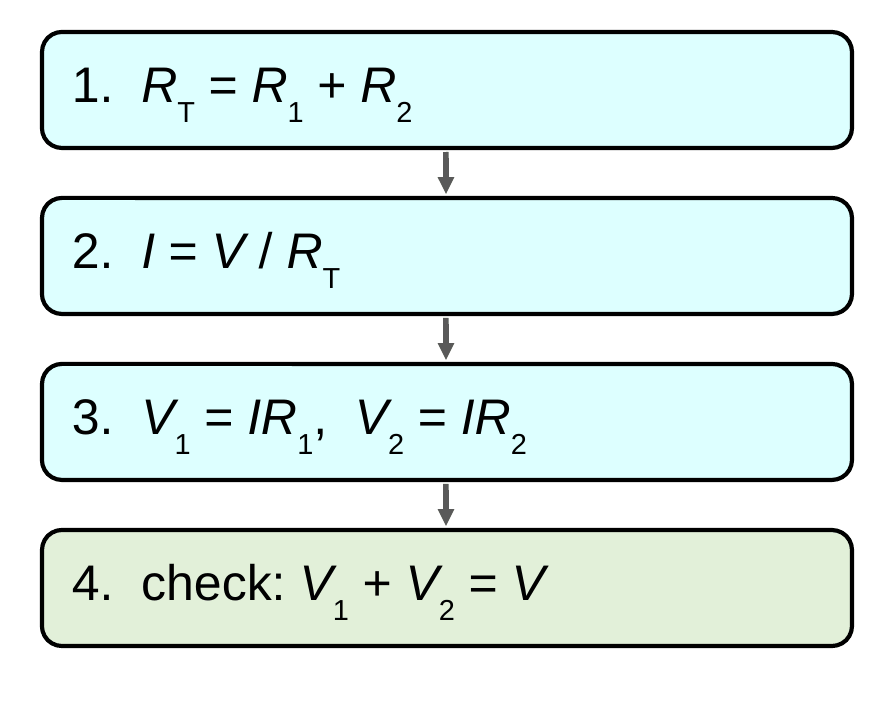
To solve a series circuit, start with the whole circuit and work toward the parts. First add the resistances to get RT. Then use Ohm’s law on the whole circuit, I = V/RT, to get the current, which is the same through every part. Next use V = IR on each resistor to get its voltage drop. Finally, check that the drops add up to the battery voltage.
Worked Examples
Try each problem on your own first, then check your work against the solution.
Example 1: Total Resistance and Current
A 12 V battery is connected in series with a 2.0 Ω resistor and a 4.0 Ω resistor. Find the total resistance and the current.
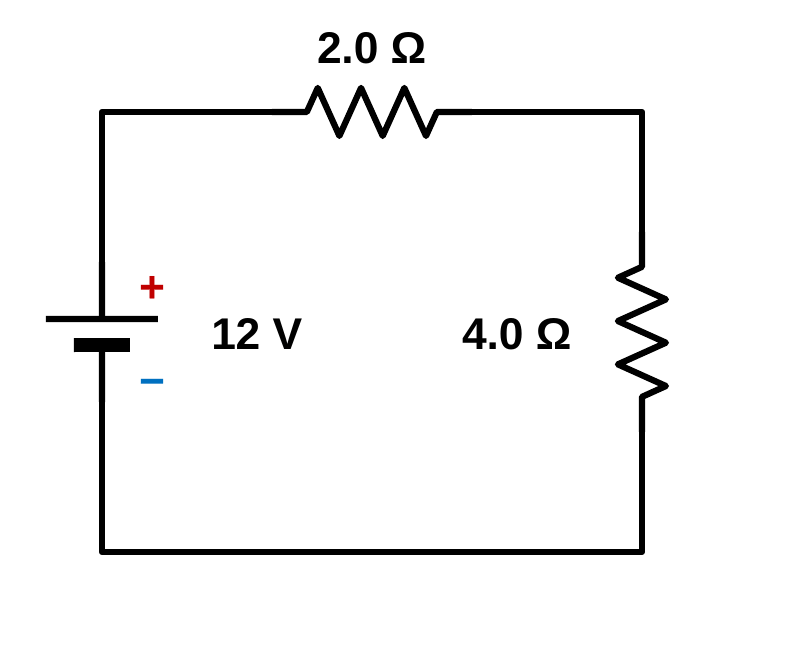
- Total resistance: RT = R1 + R2 = 2.0 Ω + 4.0 Ω = 6.0 Ω
- Current equation: I = V/RT
- Substitute: I = 12 V / 6.0 Ω
- Answer: RT = 6.0 Ω and I = 2.0 A, the same through both resistors
Example 2: Voltage Drops
An 18 V battery is in series with R1 = 3.0 Ω and R2 = 6.0 Ω. Find the voltage across each resistor.
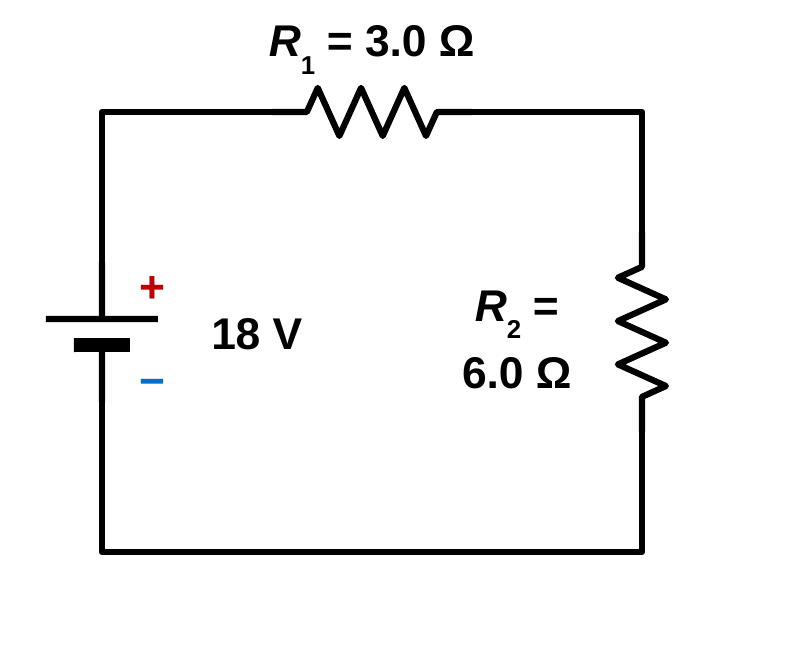
- Total resistance: RT = 3.0 Ω + 6.0 Ω = 9.0 Ω
- Current: I = V/RT = 18 V / 9.0 Ω = 2.0 A, the same through both resistors
- Each drop: V1 = IR1 = (2.0 A)(3.0 Ω) = 6.0 V, and V2 = IR2 = (2.0 A)(6.0 Ω) = 12 V
- Answer: V1 = 6.0 V and V2 = 12 V. Check: 6.0 V + 12 V = 18 V.
Example 3: Missing Resistor
A 24 V battery pushes 1.5 A through two resistors in series. One resistor is 4.0 Ω. What is the other?
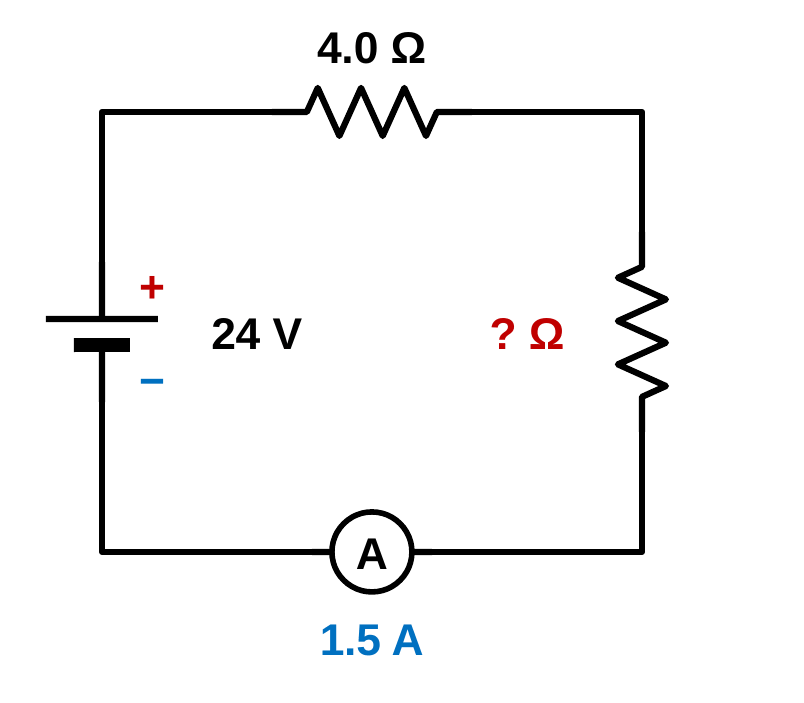
- Knowns: V = 24 V, I = 1.5 A, R1 = 4.0 Ω, R2 = ?
- Total resistance: RT = V/I = 24 V / 1.5 A = 16 Ω
- Subtract: RT = R1 + R2, so R2 = RT − R1 = 16 Ω − 4.0 Ω
- Answer: R2 = 12 Ω
Example 4: Adding a Bulb
Two identical 4.0 Ω bulbs are in series with a 12 V battery. A third identical bulb is added in series. Find the current before and after. What happens to the brightness?
- Before: RT = 4.0 Ω + 4.0 Ω = 8.0 Ω, so I = 12 V / 8.0 Ω = 1.5 A
- After: RT = 4.0 Ω + 4.0 Ω + 4.0 Ω = 12 Ω, so I = 12 V / 12 Ω = 1.0 A
- Power per bulb: before: P = I2R = (1.5 A)2(4.0 Ω) = 9.0 W. After: P = (1.0 A)2(4.0 Ω) = 4.0 W.
- Answer: The current drops from 1.5 A to 1.0 A, and every bulb gets dimmer.
Big Ideas
- One path: same current everywhere
- Voltage drops add to the battery voltage
- RT = R1 + R2 + …
- One bulb out, all out
Back to the essential question: in a series circuit, the parts share one path, so the same current flows through every part. The voltage drops add up to the battery voltage, the resistances add to give RT, and if one part breaks, everything stops. Next up, we’ll give charges more than one path with parallel circuits.

