
The video lesson for this topic is coming soon.
Essential Question
What makes charges flow through a circuit?
A circuit needs a closed loop and a battery, but how much charge flows, and how hard is it pushed? By the end of this lesson, you should be able to explain current, voltage, and resistance, and solve problems with I = q/t and ΔV = PE/q.
Electric Current
- Current: the flow of charge
- Amount of charge per second
- Unit: ampere (A)
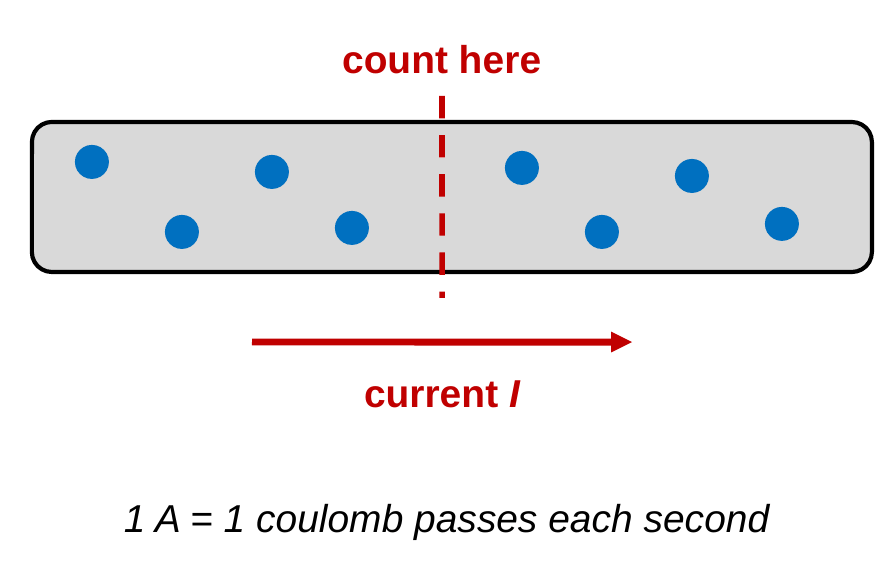
Current is the rate at which charge flows past a point in a circuit. Imagine standing at one spot in the wire and counting how many coulombs of charge go by each second. Current is measured in amperes (A), often shortened to amps. One ampere means one coulomb of charge passes each second. By convention, current points the way positive charge would move: out of the + terminal of the battery.
The Current Equation
I = q / t
- I = current, in amperes (A)
- q = charge, in coulombs (C)
- t = time, in seconds (s)
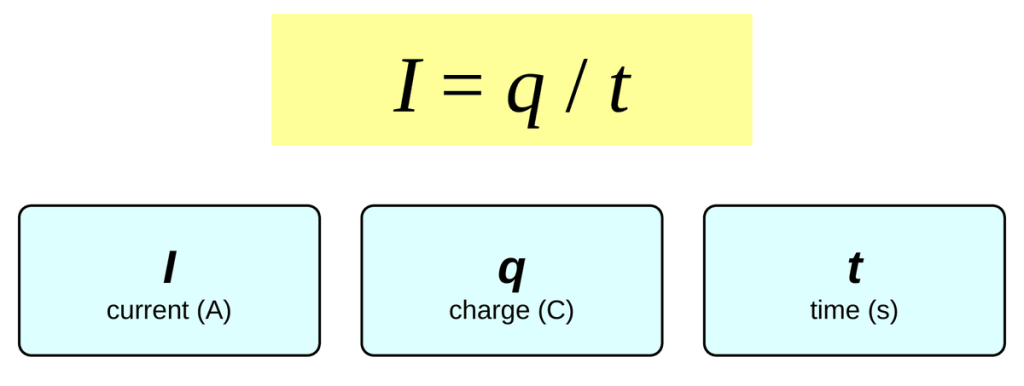
Dividing coulombs by seconds gives amperes, so 1 A = 1 C/s. The equation can be rearranged to q = It to find charge, or t = q/I to find time.
Voltage
- Energy given to each coulomb
- The “push” from the battery
- Unit: volt (V) = 1 J/C
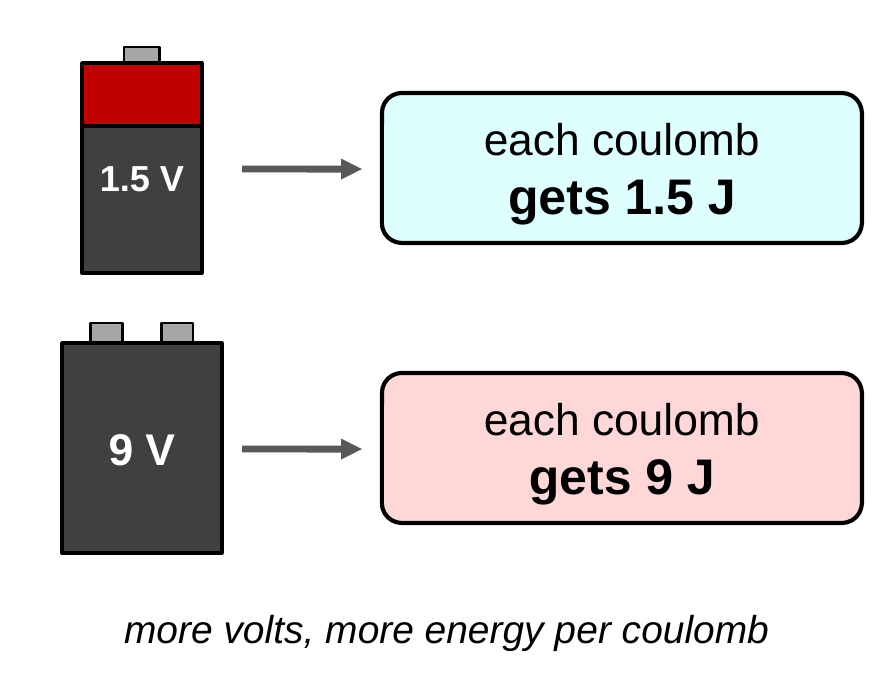
Voltage is the energy the battery gives to each coulomb of charge. It is the “push” that makes charge flow. Voltage is measured in volts (V), and one volt means one joule of energy per coulomb. A 1.5 V cell gives 1.5 J to every coulomb that passes through it, and a 9 V battery gives 9 J to every coulomb. Voltage is also called potential difference, which is why its symbol is ΔV.
The Voltage Equation
ΔV = PE / q
- ΔV = voltage (potential difference), in volts (V)
- PE = electric potential energy, in joules (J)
- q = charge, in coulombs (C)
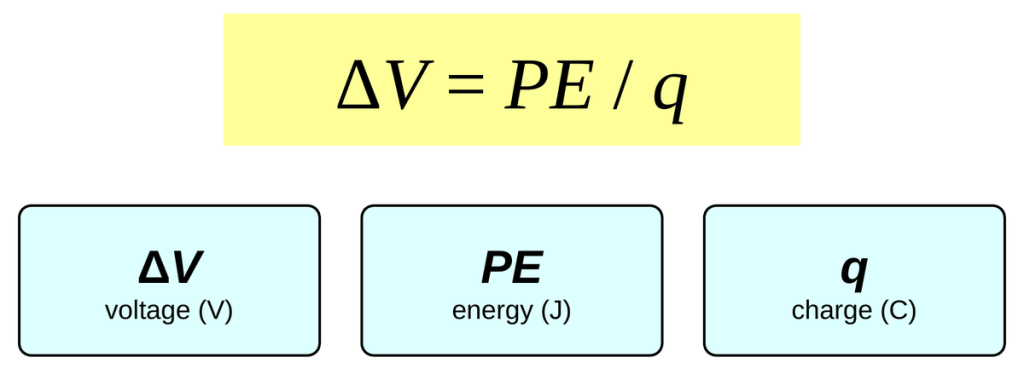
Dividing joules by coulombs gives volts, so 1 V = 1 J/C. Rearranged, PE = qΔV gives the energy a charge picks up from a battery.
Resistance
- Opposes the flow of charge
- Unit: ohm (Ω)
- More resistance, less current
- Energy turns into heat
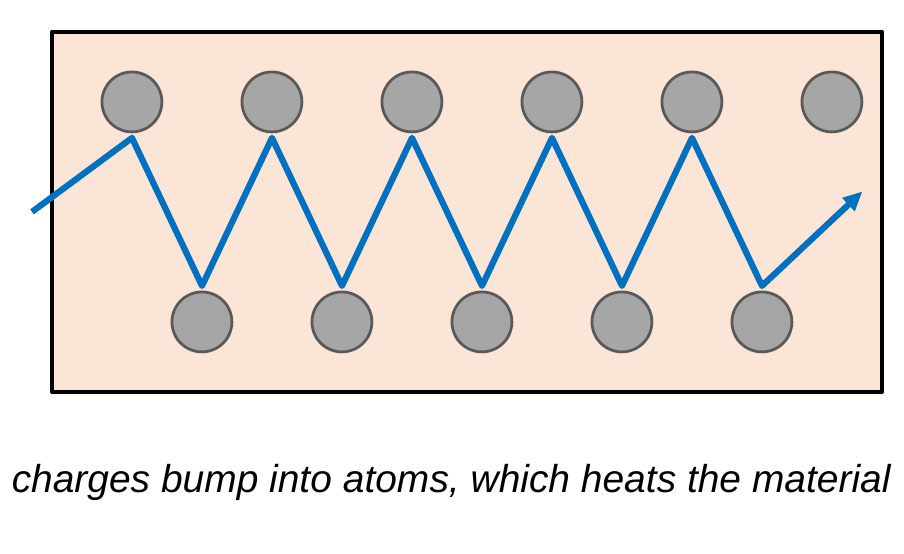
Resistance is how strongly a material opposes the flow of charge. As charges move through a material, they keep bumping into its atoms, which slows them down and turns some of their energy into heat. Resistance is measured in ohms (Ω). For the same voltage, more resistance means less current. A resistor is a part built to have a certain resistance, and a bulb’s filament is a resistor that gets hot enough to glow.
What Affects Resistance?
- Longer wire: more resistance
- Thicker wire: less resistance
- Material matters
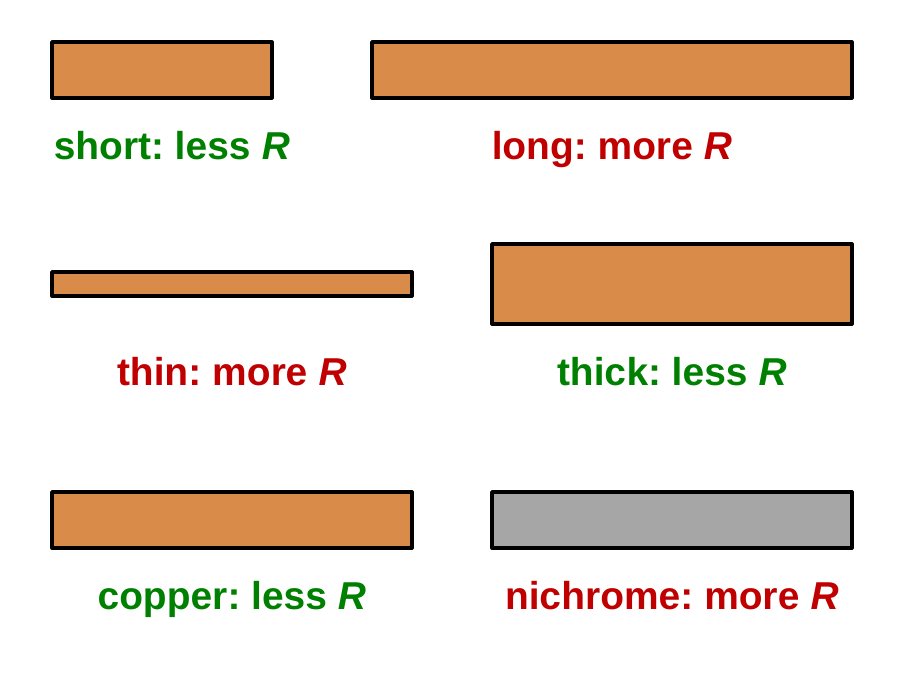
Three things control a wire’s resistance. A longer wire has more resistance, because charges bump into more atoms along the way. A thicker wire has less resistance, because it has more room for charge to flow, like a wider hallway. The material matters too: copper has very low resistance, so it is used for wires, while nichrome has high resistance, so it is used in toasters and heaters.
The Water Analogy
- Pump ↔ battery
- Water flow ↔ current
- Pump’s push ↔ voltage
- Narrow pipe ↔ resistance
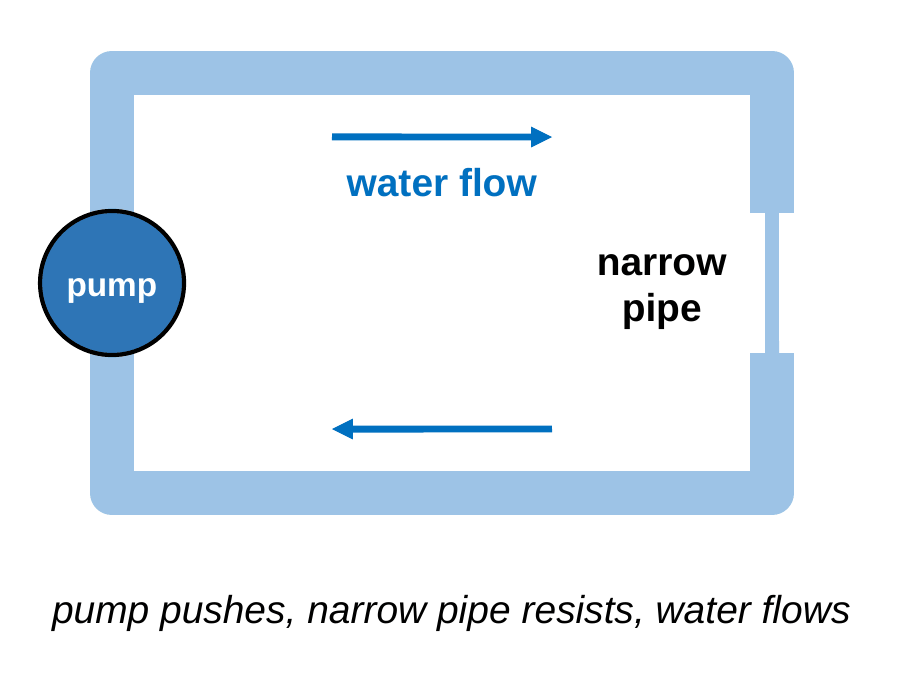
A circuit works a lot like water in a closed loop of pipe. The pump is like the battery: it gives the water a push, which is like voltage. The amount of water flowing past a point each second is like current. A narrow section of pipe makes it harder for water to get through, just like a resistor. A stronger pump or a wider pipe means more flow.
Worked Examples
Try each problem on your own first, then check your work against the solution.
Example 1: Finding Current
A total charge of 12 C flows through a bulb in 4.0 s. What is the current in the bulb?
- Knowns: q = 12 C, t = 4.0 s
- Equation: I = q/t
- Substitute: I = 12 C / 4.0 s
- Answer: I = 3.0 A. A coulomb per second is an ampere.
Example 2: Finding Charge
A toaster draws a current of 2.5 A for 30.0 s. How much charge flows through it?
- Knowns: I = 2.5 A, t = 30.0 s
- Equation: I = q/t, so q = It
- Substitute: q = (2.5 A)(30.0 s). An amp is a coulomb per second, so the seconds cancel.
- Answer: q = 75 C
Example 3: Finding Voltage
A battery gives 36 J of energy to 3.0 C of charge. What is the battery’s voltage?
- Knowns: PE = 36 J, q = 3.0 C
- Equation: ΔV = PE/q
- Substitute: ΔV = 36 J / 3.0 C
- Answer: ΔV = 12 V. A joule per coulomb is a volt.
Example 4: Finding Energy
A 9.0 V battery moves 0.50 C of charge through a circuit. How much energy does the battery give to the charge?
- Knowns: ΔV = 9.0 V, q = 0.50 C
- Equation: ΔV = PE/q, so PE = qΔV
- Substitute: PE = (0.50 C)(9.0 V). A volt is a joule per coulomb, so the coulombs cancel.
- Answer: PE = 4.5 J
Big Ideas
- Current is the flow of charge: I = q/t (A)
- Voltage is energy per charge: ΔV = PE/q (V)
- Resistance opposes current (Ω)
- Long, thin wires have more resistance
Back to the essential question: a battery’s voltage gives energy to each coulomb of charge and pushes it around the loop. The flow of charge is the current, and resistance pushes back against that flow. Next up, we’ll connect all three with Ohm’s law.

