
The video lesson for this topic is coming soon.
Essential Question
How fast do electrical devices use energy?
A phone charger and a space heater plug into the same outlet, but only one of them makes the electric bill jump. By the end of this lesson, you should be able to calculate power with P = IV, combine it with Ohm’s law, and find how much energy a device uses and what it costs.
Electric Power
- Power: how fast energy is used
- Unit: watt (symbol W) = 1 J/s
- 100 W bulb: 100 J each second
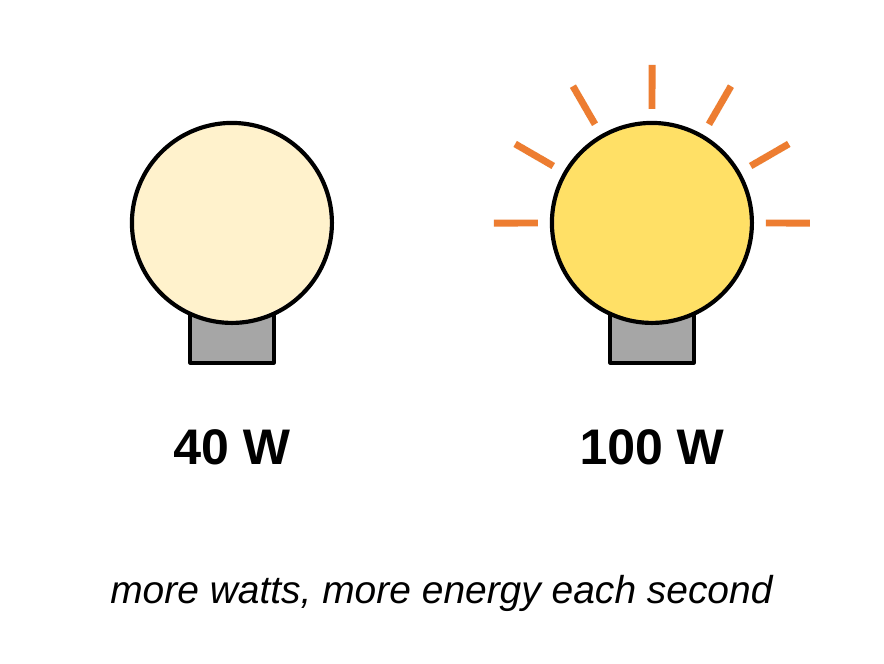
Power is the rate at which energy is transformed, or how many joules are used each second. It is measured in watts (symbol W), and 1 W = 1 J/s. A 100 W bulb transforms 100 J of electrical energy into light and heat every second. A 40 W bulb uses only 40 J each second, so it is dimmer.
The Power Equation
P = IV
- P = power, in watts (symbol W)
- I = current, in amperes (A)
- V = voltage, in volts (V)
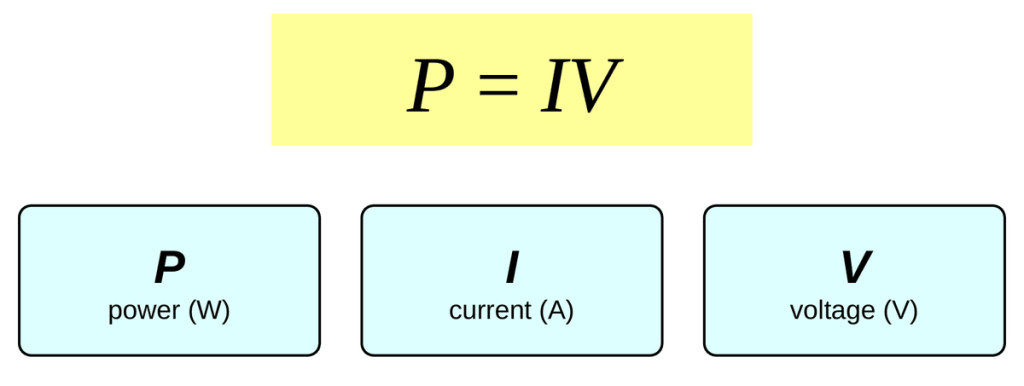
Here’s why it works: voltage is joules per coulomb, and current is coulombs per second. Multiply them and the coulombs cancel, leaving joules per second, which is watts. More current or more voltage means more power.
Where Does the Energy Go?
- Bulb: light and heat
- Toaster: heat
- Fan: motion (plus a little heat)
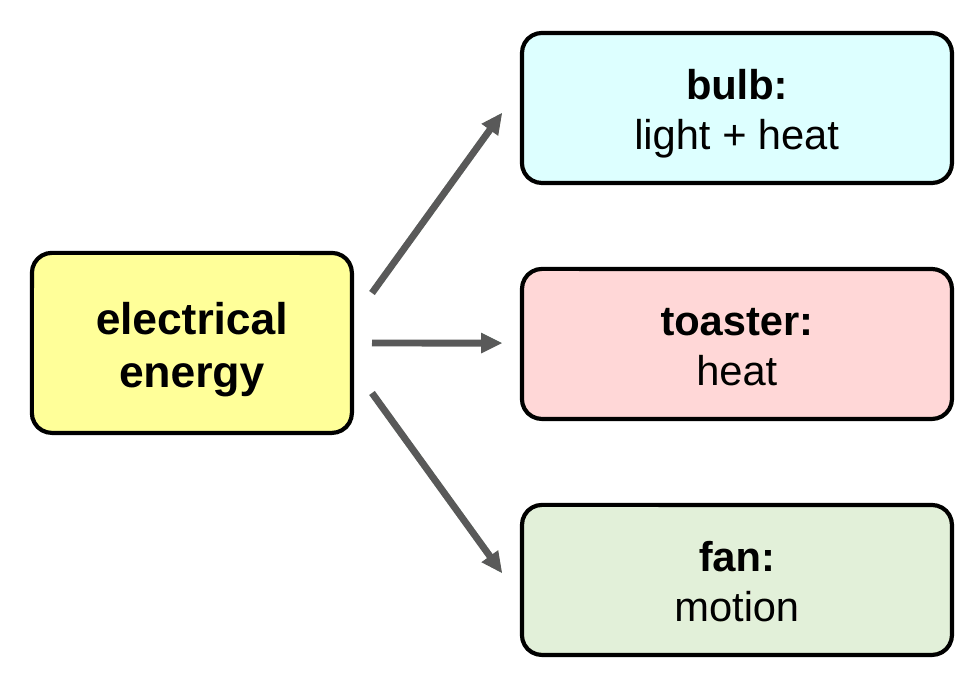
Electrical energy doesn’t disappear. It transforms into other forms. A bulb turns it into light and heat, a toaster turns almost all of it into heat, and a fan’s motor turns it into motion, with a little heat. Power tells us how fast each device does this transforming.
Combining with Ohm’s Law
- Start with P = IV
- Swap V = IR: P = I2R
- Swap I = V/R: P = V2/R
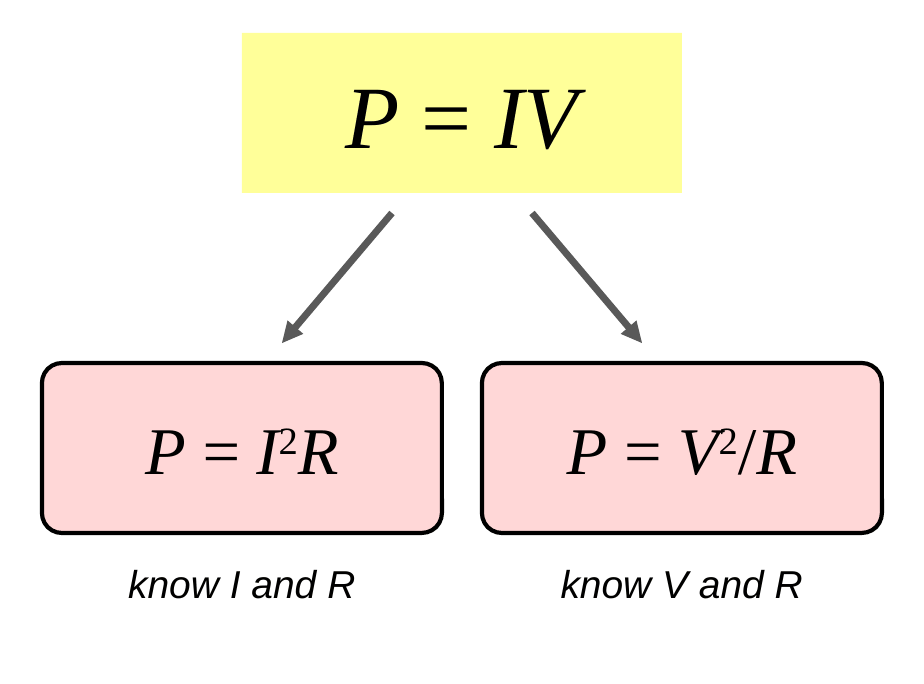
Ohm’s law lets us write power two more ways. Substituting V = IR into P = IV gives P = I(IR) = I2R. Substituting I = V/R gives P = (V/R)V = V2/R. All three give the same answer, so pick the one that matches what you know.
Electrical Energy
E = Pt
- E = energy, in joules (J)
- P = power, in watts (symbol W)
- t = time, in seconds (s)
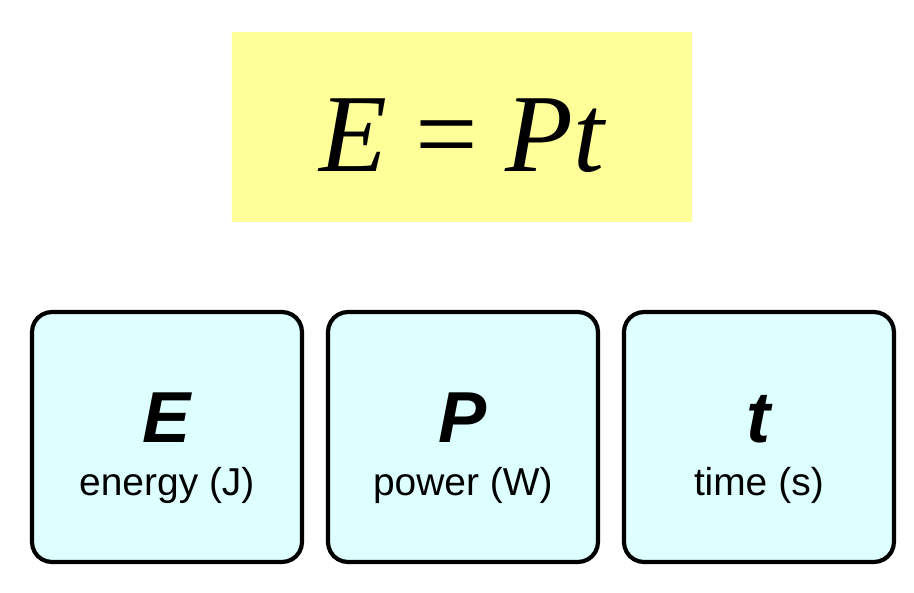
Power is energy per second, so the total energy a device uses is its power times how long it runs. A 100 W bulb left on for 60 s uses (100 J/s)(60 s) = 6,000 J.
Kilowatt-Hours
- The power company’s energy unit
- kilowatts × hours = kWh
- 1 kWh = 3.6 × 10⁶ J
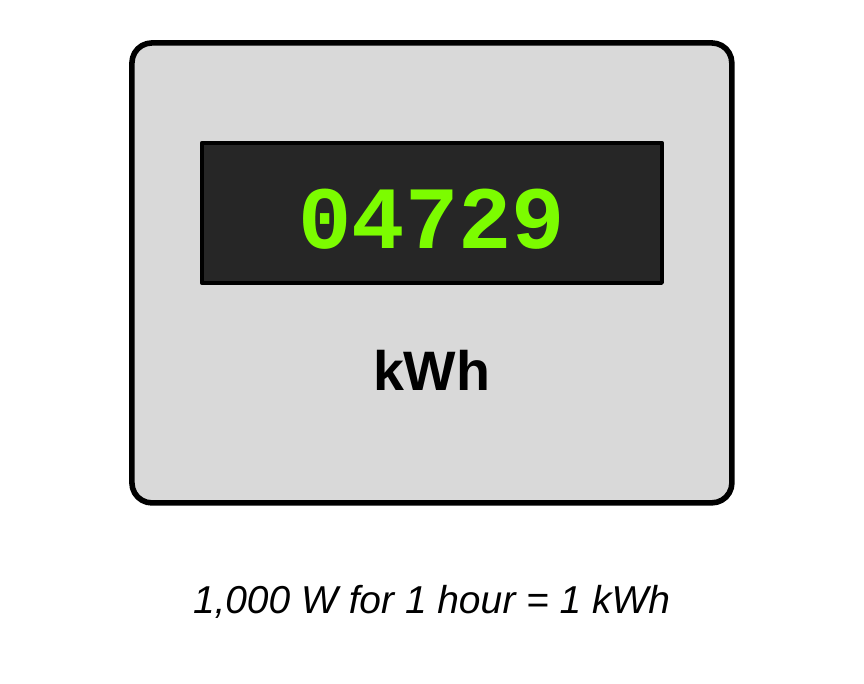
The power company measures energy in kilowatt-hours (kWh): power in kilowatts multiplied by time in hours. A 1,000 W (1 kW) device running for 1 hour uses 1 kWh. Converting, 1 kWh = (1,000 J/s)(3,600 s) = 3.6 × 10⁶ J. Your electric bill is the number of kilowatt-hours you used times the price per kWh.
Worked Examples
Try each problem on your own first, then check your work against the solution.
Example 1: Finding Power
A car headlight draws a current of 4.5 A from a 12 V battery. What is the power of the headlight?
- Knowns: I = 4.5 A, V = 12 V
- Equation: P = IV
- Substitute: P = (4.5 A)(12 V)
- Answer: P = 54 W
Example 2: Finding Current
A 60.0 W light bulb is plugged into a 120. V outlet. What current does it draw?
- Knowns: P = 60.0 W, V = 120. V
- Equation: P = IV, so I = P/V
- Substitute: I = 60.0 W / 120. V
- Answer: I = 0.500 A
Example 3: Power from Resistance
A heating coil has a resistance of 7.0 Ω and carries a current of 3.0 A. What is its power?
- Knowns: R = 7.0 Ω, I = 3.0 A
- Equation: we know I and R, so use P = I2R
- Substitute: P = (3.0 A)2(7.0 Ω) = (9.0 A2)(7.0 Ω)
- Answer: P = 63 W
Check with the other method: V = IR = (3.0 A)(7.0 Ω) = 21 V, and P = IV = (3.0 A)(21 V) = 63 W. Same answer.
Example 4: Cost of Energy
A 1.5 kW space heater runs 4.0 hours a day for 30 days. Electricity costs $0.15 per kWh. How much does it cost to run?
- Knowns: P = 1.5 kW, t = (4.0 h/day)(30 days) = 120 h, price = $0.15 per kWh
- Energy: E = Pt = (1.5 kW)(120 h) = 180 kWh
- Cost: cost = (180 kWh)($0.15 per kWh)
- Answer: cost = $27
Big Ideas
- Power is how fast energy is used, in watts
- P = IV = I2R = V2/R
- Energy: E = Pt
- Electric bills use kilowatt-hours
Back to the essential question: electrical devices use energy at a rate called power, measured in watts. We find it with P = IV, or with P = I2R and P = V2/R, and the total energy used is E = Pt. Next up, we’ll connect several parts in one loop to build series circuits.

