
The video lesson for this topic is coming soon.
Essential Question
How do we solve a circuit that has series and parallel parts?
Most real circuits mix series and parallel parts. You already know all the rules you need. By the end of this lesson, you should be able to find the total resistance of a combination circuit and then the current and voltage for every resistor in it.
Series and Parallel Together
- Some parts in series
- Some parts in parallel
- Find the groups first
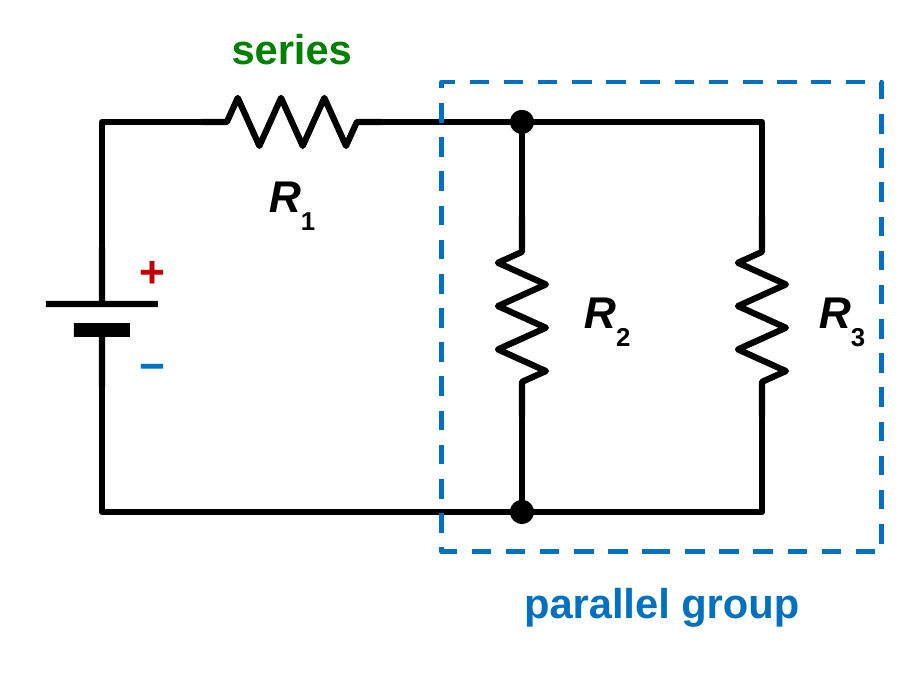
A combination circuit has some parts in series and some in parallel. Here, all of the current passes through R1, so R1 is in series with the rest of the circuit. Then the current splits between R2 and R3, which form a parallel group. The first job is always to spot these groups.
Step 1: Simplify Parallel Groups
- Find each parallel group
- Replace it with one resistor
- Use the 1/R rule
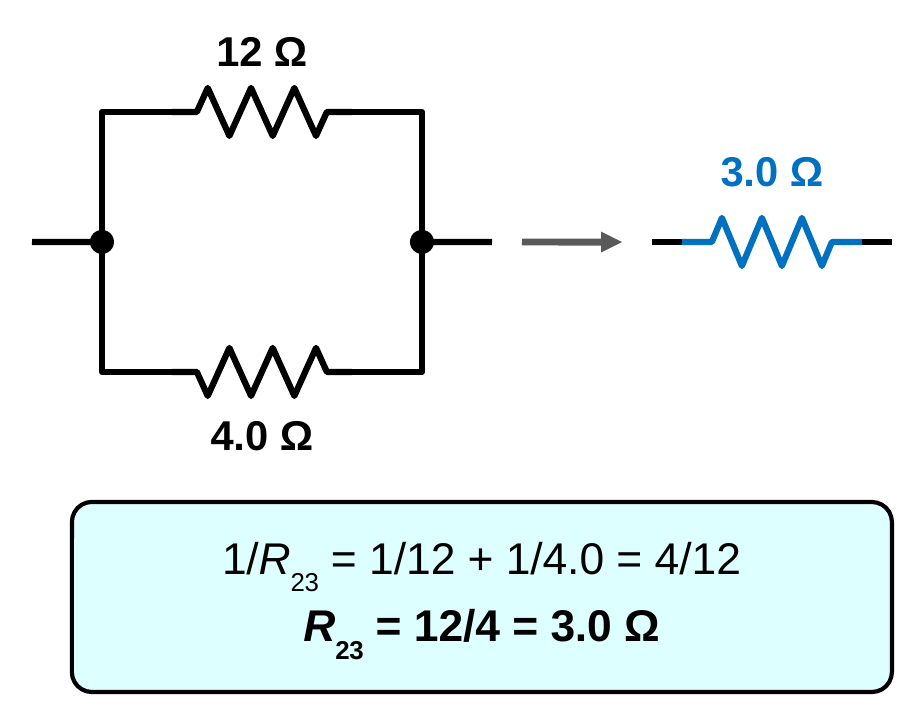
Start with the parallel group, because it has to be replaced before anything can be added in series. For R2 = 12 Ω and R3 = 4.0 Ω in parallel: 1/R23 = 1/12 + 1/4.0 = 1/12 + 3/12 = 4/12, so R23 = 3.0 Ω. The two branches act exactly like a single 3.0 Ω resistor.
Step 2: Add the Series Parts
- Now it’s a simple loop
- RT = R1 + R23
- Then I = V/RT
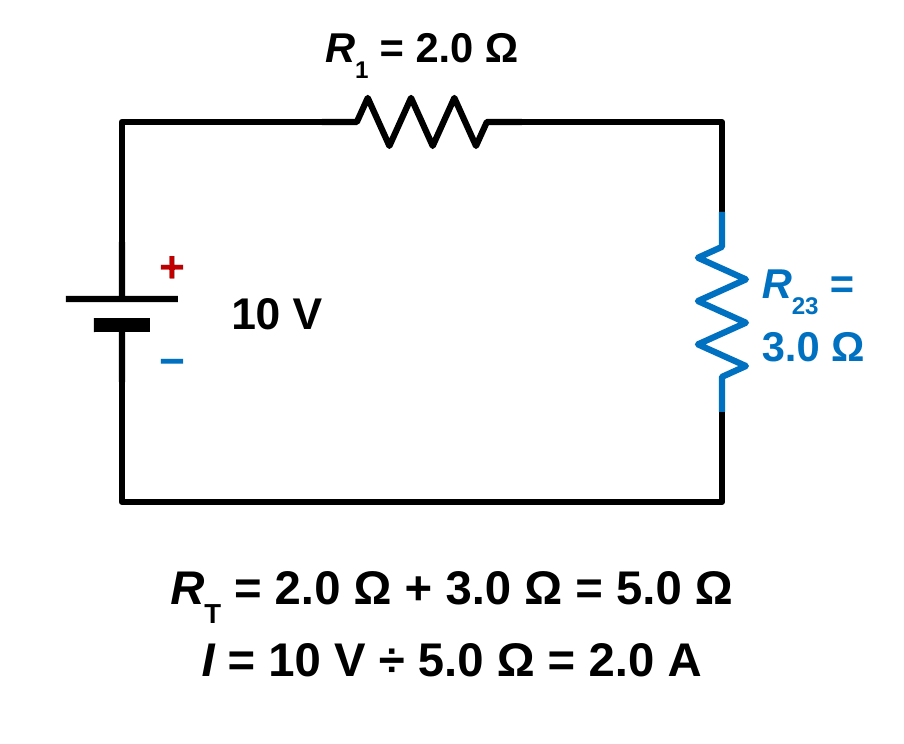
With the parallel group replaced by R23 = 3.0 Ω, the circuit is a single loop, so the series rule applies: RT = R1 + R23 = 2.0 Ω + 3.0 Ω = 5.0 Ω. Now use Ohm’s law on the whole circuit: I = V/RT = 10 V ÷ 5.0 Ω = 2.0 A. This is the total current from the battery.
Step 3: Work Backward
- Series part: use the total I
- Parallel group shares one V
- Use V = IR for each part
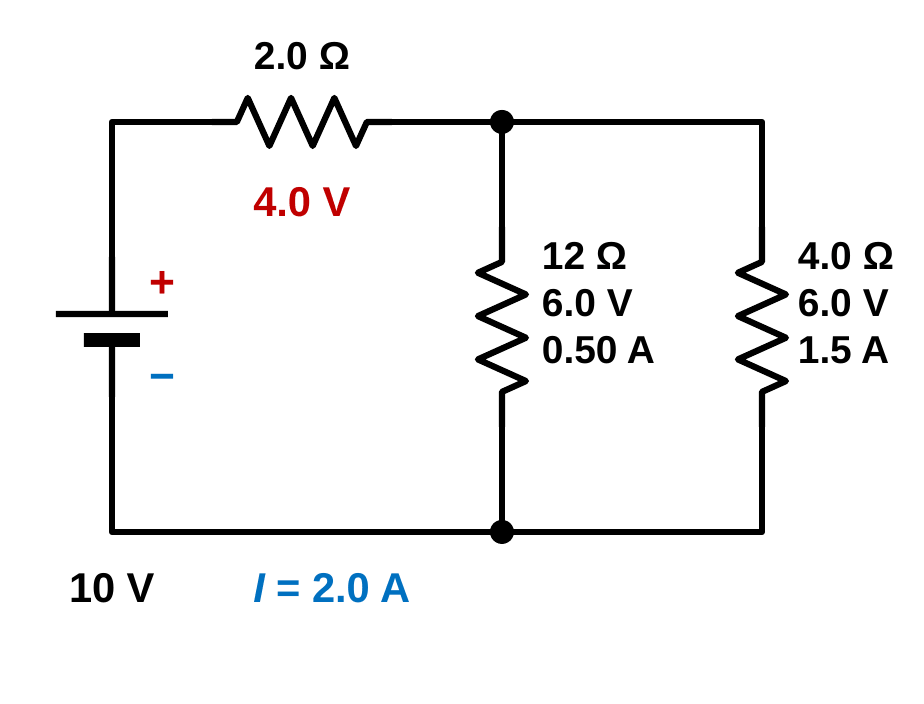
Now return to the original circuit. All 2.0 A flows through R1, so V1 = IR1 = (2.0 A)(2.0 Ω) = 4.0 V. The parallel group gets the rest of the battery voltage: V23 = IR23 = (2.0 A)(3.0 Ω) = 6.0 V, and both branches share that same 6.0 V. Then each branch gets its own current: I2 = 6.0 V ÷ 12 Ω = 0.50 A and I3 = 6.0 V ÷ 4.0 Ω = 1.5 A.
Check with the Rules
- Junction rule: in = out
- Loop rule: drops = battery
- Both must check out
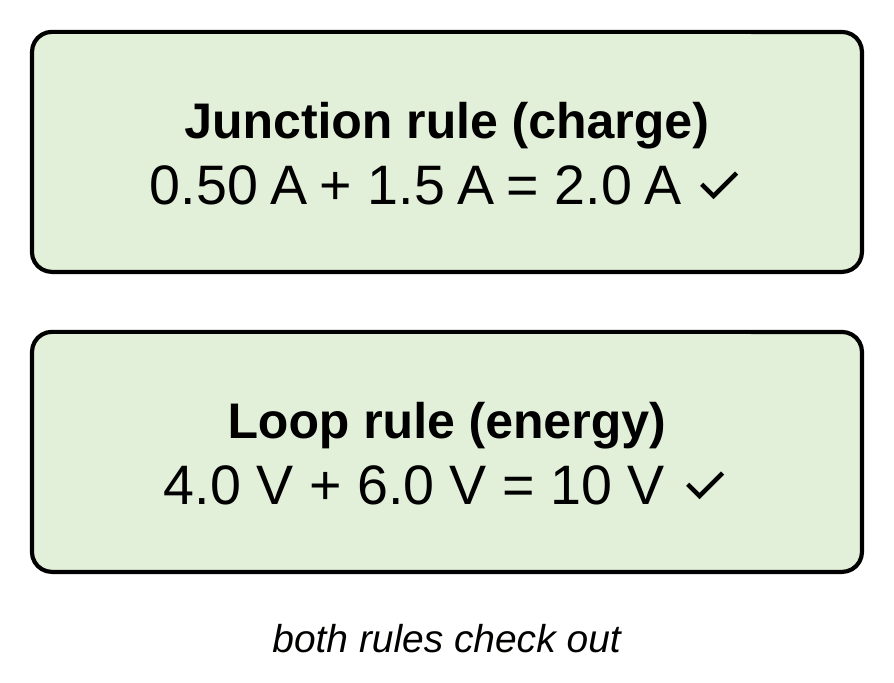
Two rules let you check your work. The junction rule (conservation of charge) says the current into a junction equals the current out: 0.50 A + 1.5 A = 2.0 A. The loop rule (conservation of energy) says the voltage drops around any loop add up to the battery voltage: going through R1 and either branch, 4.0 V + 6.0 V = 10 V. If either check fails, look for a mistake.
A Solving Table
- Track R, I, V for each part
- Fill in what you know
- Use V = IR on each row
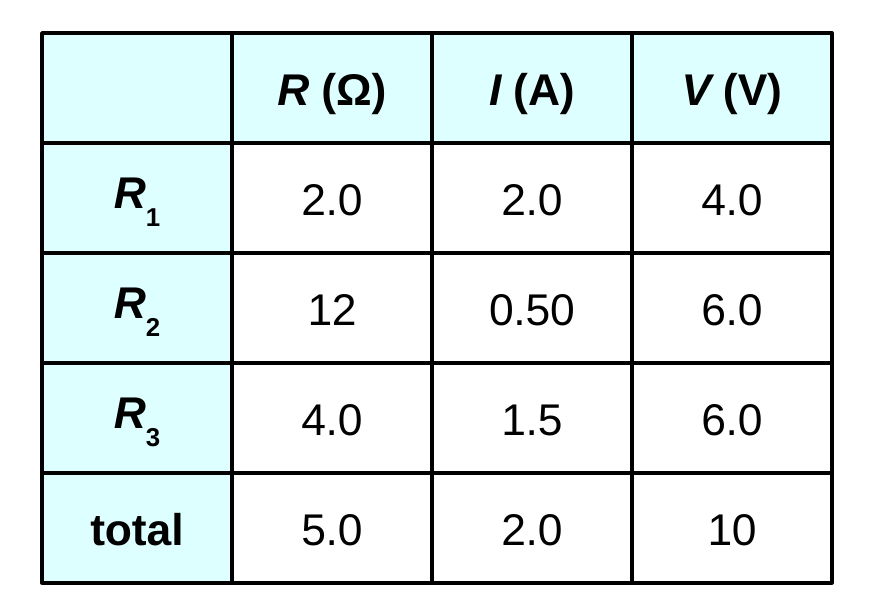
A table keeps a combination circuit organized. Make a row for each resistor and one for the total, with columns for R, I, and V. Fill in the given values first, then fill in the rest. Every row must follow V = IR, so if you know any two boxes in a row, you can find the third.
Worked Examples
Try each problem on your own first, then check your work against the solution.
Example 1: Total Resistance
An 18 V battery is connected to R1 = 4.0 Ω in series with a parallel pair, R2 = 6.0 Ω and R3 = 3.0 Ω. Find the total resistance.
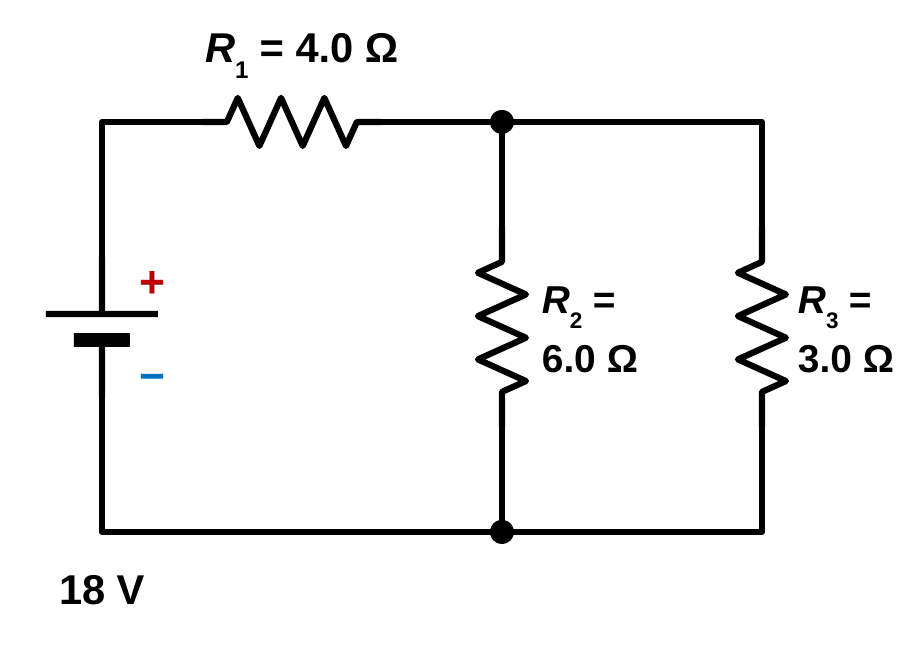
- Parallel group: 1/R23 = 1/6.0 + 1/3.0 = 1/6.0 + 2/6.0 = 3/6.0, so R23 = 6.0/3 = 2.0 Ω
- Series parts: RT = R1 + R23
- Substitute: RT = 4.0 Ω + 2.0 Ω
- Answer: RT = 6.0 Ω
Example 2: Current and Voltages
An 18 V battery is connected to R1 = 4.0 Ω in series with a parallel pair, R2 = 6.0 Ω and R3 = 3.0 Ω (the circuit from Example 1, where RT = 6.0 Ω and R23 = 2.0 Ω). Find the total current, the voltage across R1, and the voltage across the parallel pair.
- Total current: I = V/RT = 18 V / 6.0 Ω = 3.0 A
- Voltage across R1: all of the current passes through R1, so V1 = IR1 = (3.0 A)(4.0 Ω) = 12 V
- Voltage across the pair: V23 = IR23 = (3.0 A)(2.0 Ω) = 6.0 V
- Answer: I = 3.0 A, V1 = 12 V, V23 = 6.0 V. Loop rule check: 12 V + 6.0 V = 18 V.
Example 3: Branch Currents
In the circuit from Examples 1 and 2 (18 V battery, R1 = 4.0 Ω in series with R2 = 6.0 Ω and R3 = 3.0 Ω in parallel), the voltage across the parallel pair is 6.0 V and the total current is 3.0 A. Find the current through R2 and through R3.
- Branch voltage: R2 and R3 are in parallel, so each has 6.0 V across it
- Through R2: I2 = V/R2 = 6.0 V / 6.0 Ω = 1.0 A
- Through R3: I3 = V/R3 = 6.0 V / 3.0 Ω = 2.0 A
- Answer: I2 = 1.0 A and I3 = 2.0 A. Junction rule check: 1.0 A + 2.0 A = 3.0 A, the total current.
Example 4: Series Inside a Branch
A 12 V battery is connected to two branches in parallel. One branch has R1 = 2.0 Ω and R2 = 4.0 Ω in series. The other has R3 = 3.0 Ω. Find RT and the total current.
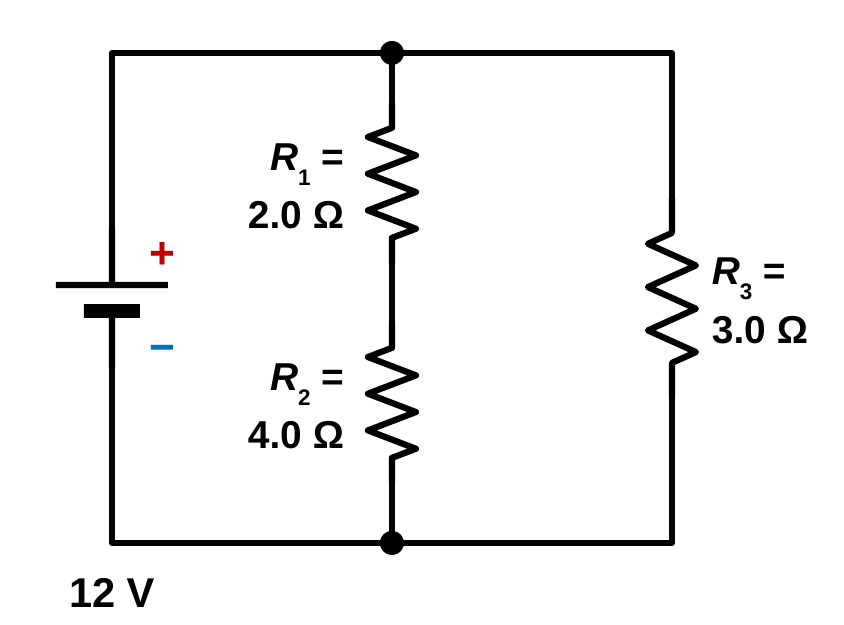
- Series inside the branch: R12 = R1 + R2 = 2.0 Ω + 4.0 Ω = 6.0 Ω
- Parallel branches: 1/RT = 1/6.0 + 1/3.0 = 3/6.0, so RT = 2.0 Ω
- Total current: I = V/RT = 12 V / 2.0 Ω
- Answer: RT = 2.0 Ω and I = 6.0 A
Check: each branch gets 12 V, so the first branch carries 12 V / 6.0 Ω = 2.0 A and the second carries 12 V / 3.0 Ω = 4.0 A. Together that’s 6.0 A.
Big Ideas
- Simplify groups, starting with the innermost
- Add the series parts to get RT
- I = V/RT, then work backward
- Check: junction rule and loop rule
Back to the essential question: we simplify it step by step. Replace each parallel group with one equivalent resistor, add the series parts to get RT, and find the total current with I = V/RT. Then work backward with V = IR, the junction rule, and the loop rule to find the current and voltage for every part. This wraps up our unit on electric circuits.

