
The video lesson for this topic is coming soon.
Essential Question
What happens when a circuit gives charges more than one path?
In a series circuit, one dead bulb turns everything off. Your house isn’t wired that way. By the end of this lesson, you should be able to find the voltage, current, and total resistance in a parallel circuit, where charges have more than one path.
Multiple Branches
- Each part on its own branch
- Charge splits at a junction
- Paths rejoin at the bottom
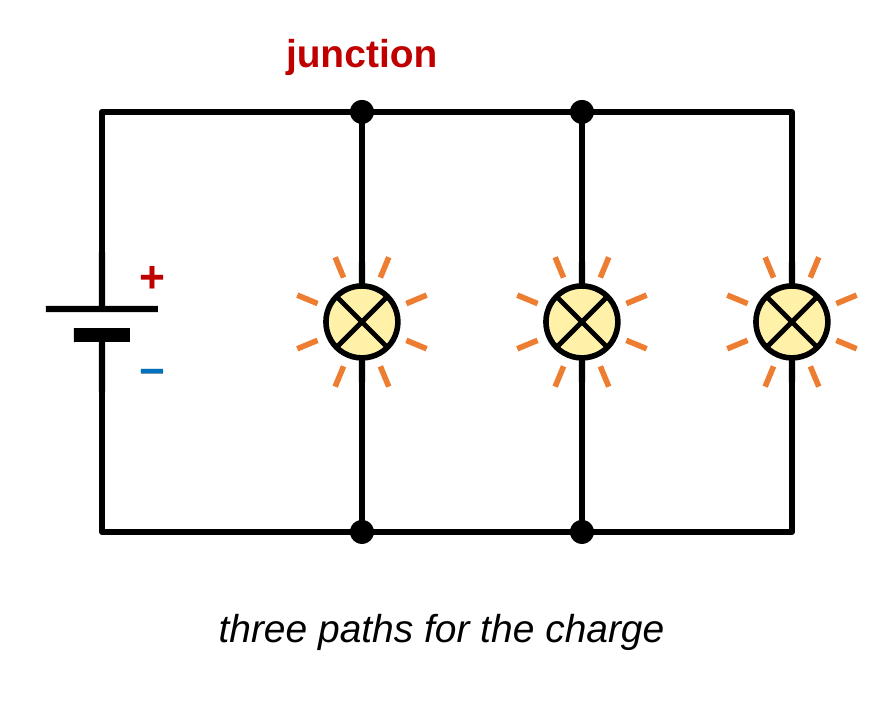
In a parallel circuit, each part sits on its own branch. Charge leaving the battery reaches a junction, a point where the wire splits, and divides among the branches. The branches come back together at another junction before returning to the battery. Each charge only goes through one of the bulbs, not all of them.
Same Voltage on Each Branch
- Each branch spans the battery
- Every branch gets the full voltage
- V = V1 = V2
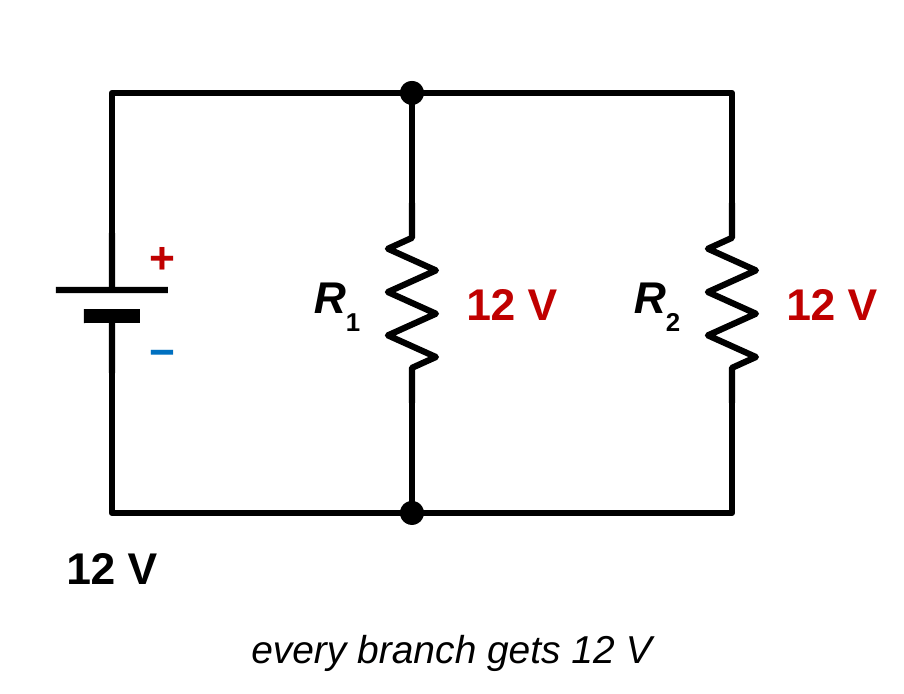
Each branch connects directly from the top wire to the bottom wire, so each one sits right across the battery. That means every branch gets the full battery voltage. With a 12 V battery, each coulomb gives up 12 J in whichever branch it takes. So in a parallel circuit, V = V1 = V2 = ….
Currents Add at Junctions
- Current splits at a junction
- Charge in = charge out
- I = I1 + I2
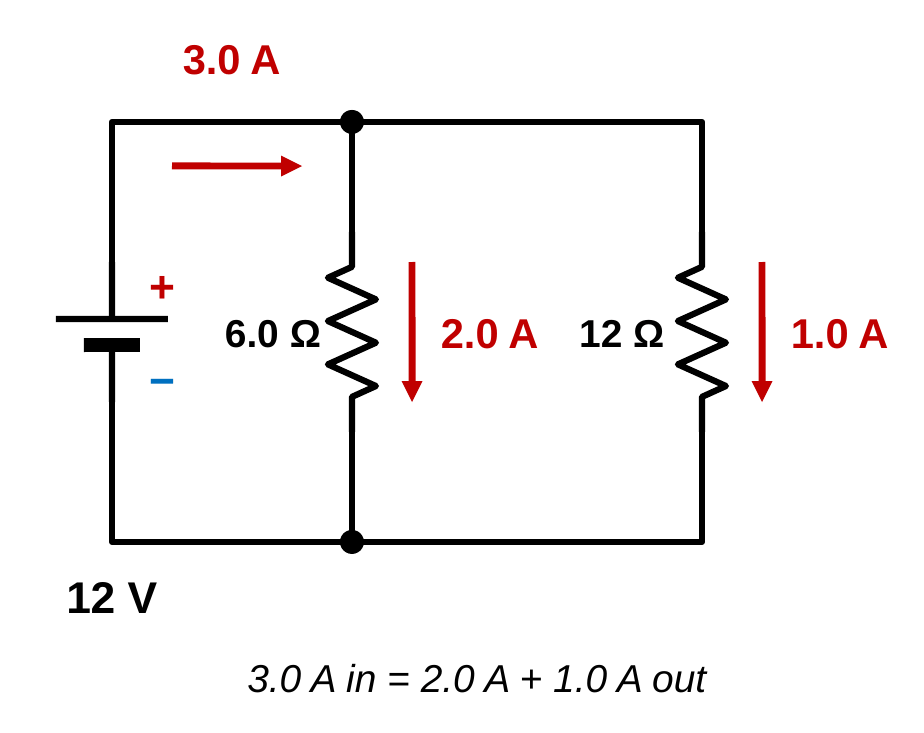
At a junction, the current splits among the branches, and the branch currents add up to the total current: I = I1 + I2 + …. This is conservation of charge: charge can’t pile up at a junction or disappear, so whatever flows in must flow out. Each branch current follows Ohm’s law with the full battery voltage. Here the 6.0 Ω branch carries 12 V ÷ 6.0 Ω = 2.0 A and the 12 Ω branch carries 12 V ÷ 12 Ω = 1.0 A, so the battery supplies 3.0 A. The smaller resistance gets the bigger current.
Total Resistance
1/R_T = 1/R_1 + 1/R_2 + …
- 1/RT = 1/R1 + 1/R2 + …
- Flip the answer to get RT
- RT is smaller than any branch
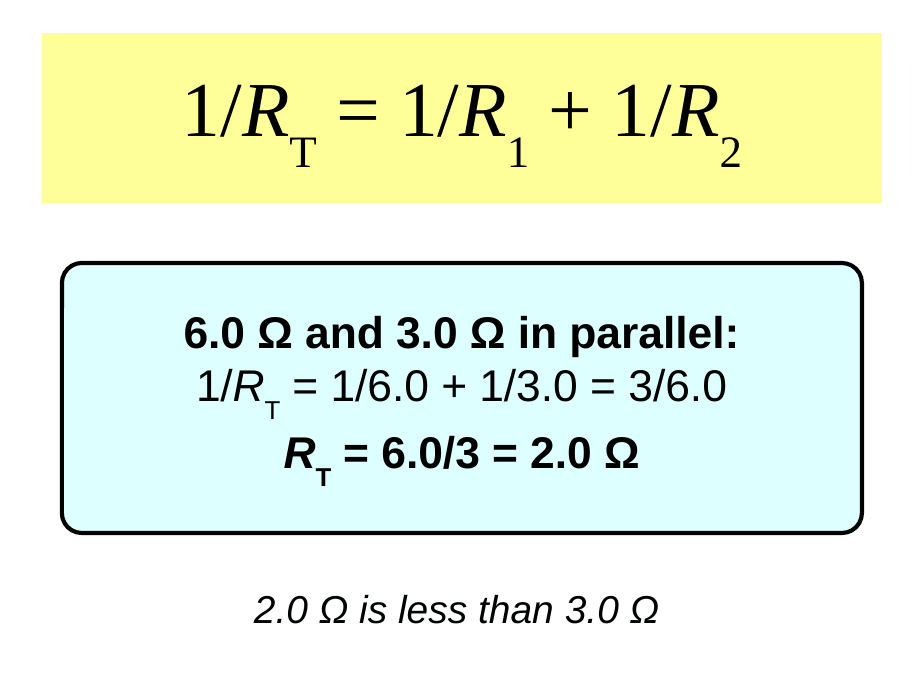
For resistors in parallel, add the reciprocals (one over each resistance), then flip the result to get RT. For 6.0 Ω and 3.0 Ω: 1/RT = 1/6.0 + 1/3.0 = 1/6.0 + 2/6.0 = 3/6.0, so RT = 6.0/3 = 2.0 Ω. The total resistance of a parallel group is always smaller than its smallest branch, because every branch adds another path for charge.
More Branches, Less Resistance
- Each branch is a new path
- Like more checkout lanes
- Total current goes up
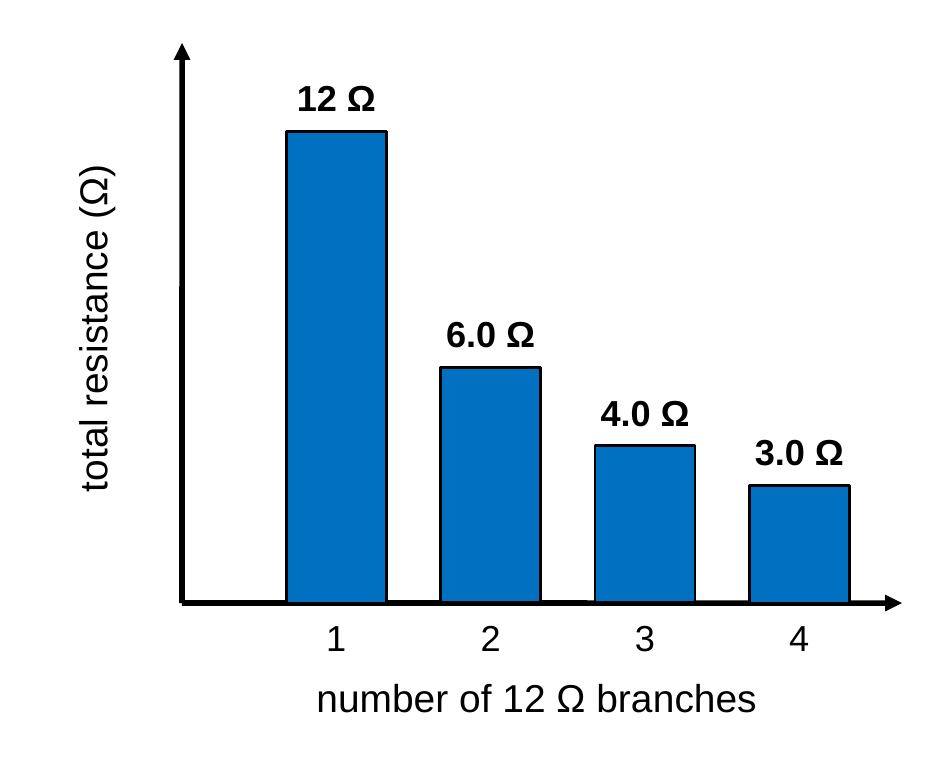
Every new branch gives the charge another path, so adding branches lowers the total resistance, like opening more checkout lanes at a store. With identical 12 Ω branches, one branch gives 12 Ω, two give 6.0 Ω, three give 4.0 Ω, and four give 3.0 Ω. Since the battery voltage stays the same, a lower total resistance means the battery supplies more total current. Each branch still gets the same voltage and the same current as before, so the bulbs already on don’t get dimmer.
Household Wiring
- Outlets are wired in parallel
- Every device gets 120 V
- Each device works on its own
- Too much current trips the breaker
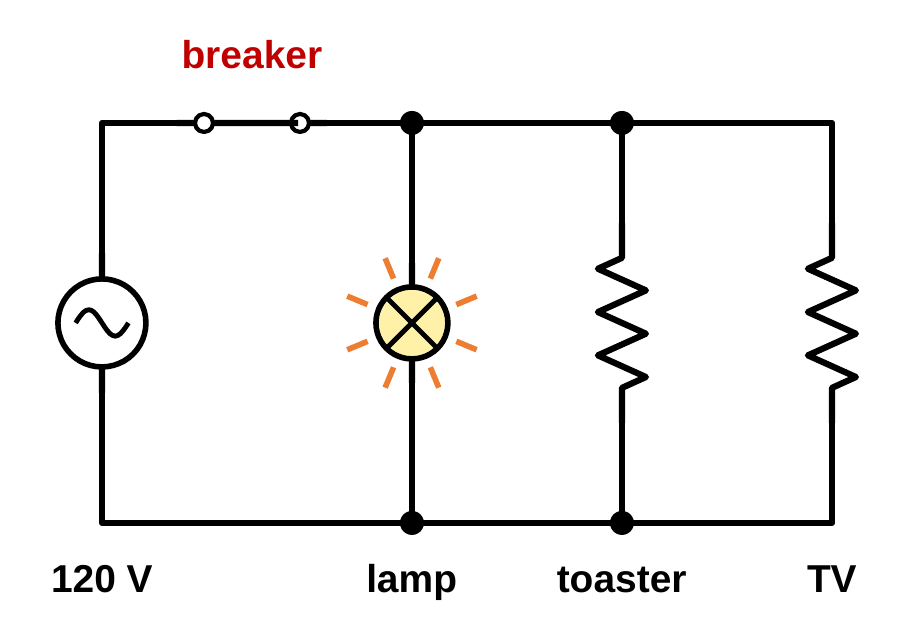
Homes are wired in parallel. Every outlet connects across the same two wires, so every device gets the full 120 V, and each one can be switched on or off without affecting the others. The catch: each device you turn on adds another branch, which lowers the total resistance and raises the total current in the wires. If the current gets too big, the wires could overheat, so a circuit breaker in series with the whole circuit opens and cuts the power.
Worked Examples
Try each problem on your own first, then check your work against the solution.
Example 1: Total Resistance
A 6.0 Ω resistor and a 12 Ω resistor are connected in parallel. What is their total resistance?
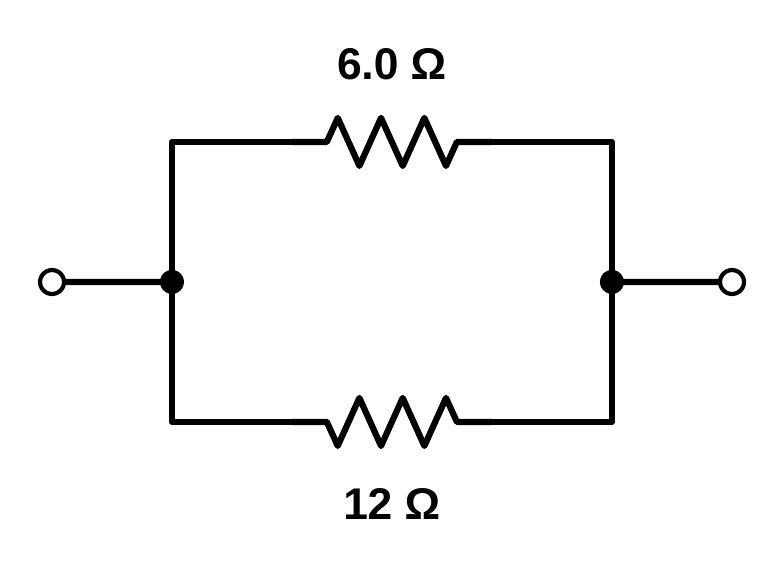
- Equation: 1/RT = 1/R1 + 1/R2
- Substitute: 1/RT = 1/6.0 Ω + 1/12 Ω = 2/12 + 1/12 = 3/12 (in 1/Ω)
- Flip: RT = 12/3 Ω
- Answer: RT = 4.0 Ω, which is less than the smaller resistor (6.0 Ω), as it should be
Example 2: Branch Currents
A 12 V battery is connected to a 4.0 Ω resistor and a 6.0 Ω resistor in parallel. Find the current in each branch and the total current.
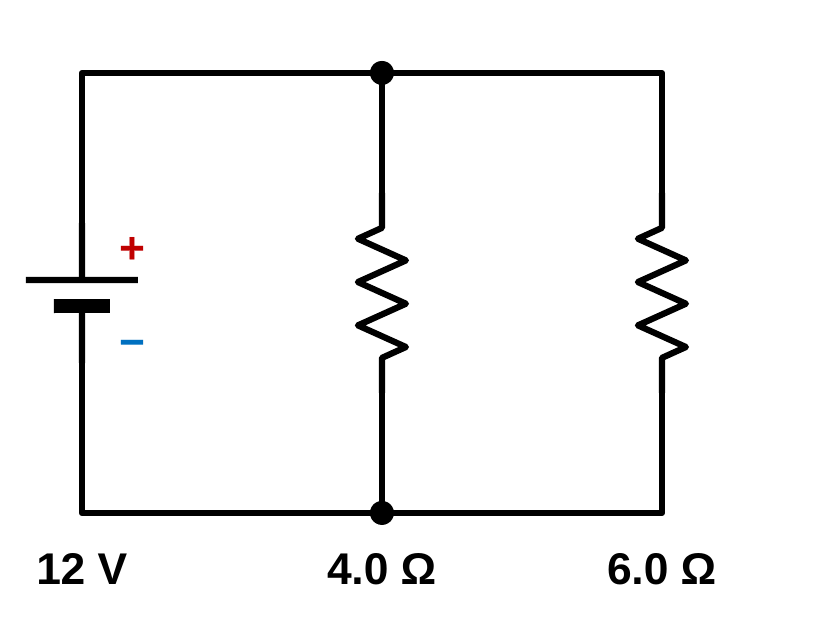
- Branch voltage: in parallel, each branch gets the full 12 V
- Branch 1: I1 = V/R1 = 12 V / 4.0 Ω = 3.0 A
- Branch 2: I2 = V/R2 = 12 V / 6.0 Ω = 2.0 A
- Answer: I1 = 3.0 A, I2 = 2.0 A, and I = 3.0 A + 2.0 A = 5.0 A
Check: 1/RT = 1/4.0 + 1/6.0 = 5/12, so RT = 2.4 Ω, and 12 V / 2.4 Ω = 5.0 A. Same total.
Example 3: Three Branches
A 6.0 V battery is connected to three resistors in parallel: 2.0 Ω, 3.0 Ω, and 6.0 Ω. Find the total resistance and the total current.
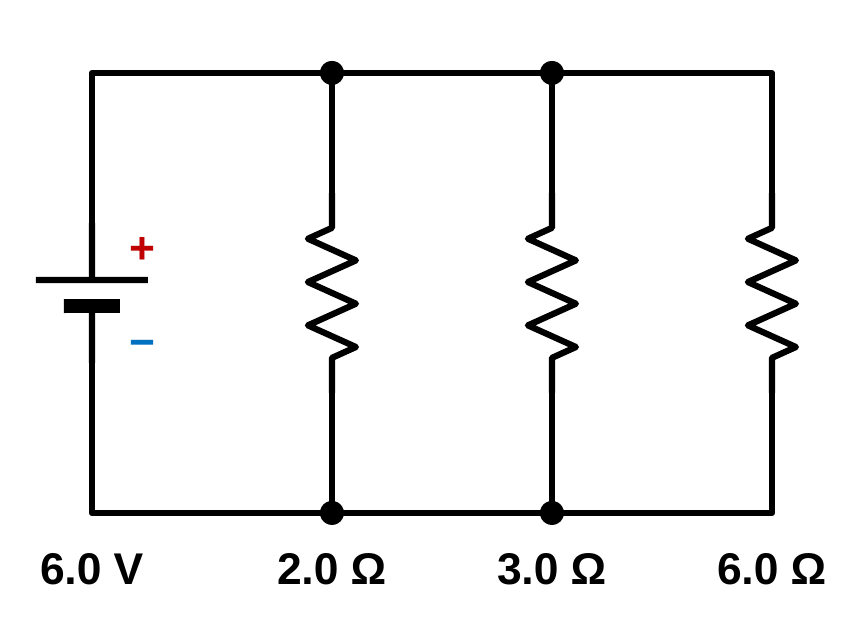
- Add reciprocals: 1/RT = 1/2.0 + 1/3.0 + 1/6.0 = 3/6 + 2/6 + 1/6 = 6/6 = 1 (in 1/Ω)
- Flip: RT = 1/1 = 1.0 Ω
- Total current: I = V/RT = 6.0 V / 1.0 Ω
- Answer: RT = 1.0 Ω and I = 6.0 A
Check with branch currents: 6.0 V / 2.0 Ω = 3.0 A, 6.0 V / 3.0 Ω = 2.0 A, and 6.0 V / 6.0 Ω = 1.0 A. Together they add to 6.0 A.
Example 4: Kitchen Circuit
A 120 V kitchen circuit has a 15 A breaker. A 16 Ω toaster and a 15 Ω microwave are plugged in at the same time. Will the breaker trip?
- Branch voltage: household outlets are in parallel, so each appliance gets 120 V
- Toaster: I1 = 120 V / 16 Ω = 7.5 A
- Microwave: I2 = 120 V / 15 Ω = 8.0 A
- Total current: I = 7.5 A + 8.0 A = 15.5 A
- Answer: Yes. 15.5 A is more than the 15 A limit, so the breaker trips.
Big Ideas
- Every branch gets the full voltage
- Currents add: I = I1 + I2 + …
- 1/RT = 1/R1 + 1/R2 + …
- More branches, less RT, more I
Back to the essential question: in a parallel circuit, every branch gets the full battery voltage, the branch currents add up to the total current, and each added branch lowers the total resistance. Each branch also works on its own, which is why homes are wired in parallel. Next up, we’ll solve circuits that mix series and parallel parts.

