
The video lesson for this topic is coming soon.
Essential Question
How fast does a wave travel?
Waves repeat over and over, and they travel from place to place. By the end of this lesson, you should be able to find the period and frequency of a wave and use v = fλ to solve for a wave’s speed, frequency, or wavelength.
Period
- Time for one full cycle
- Symbol T
- Unit: seconds (s)
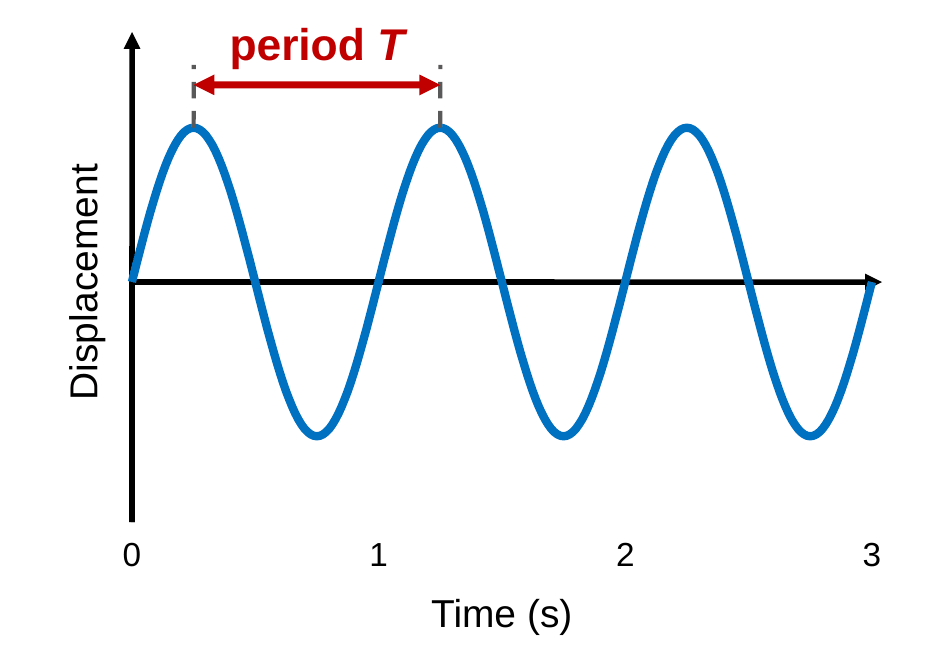
The period (T) is the time it takes for one full cycle of a wave to pass a point. On a graph of displacement versus time, you can measure it from one crest to the next crest. The wave on this graph has a period of 1.0 s. Period is a time, so it is measured in seconds.
Frequency
- Cycles per second
- Symbol f
- Unit: hertz (Hz)
- 1 Hz = 1 cycle per second
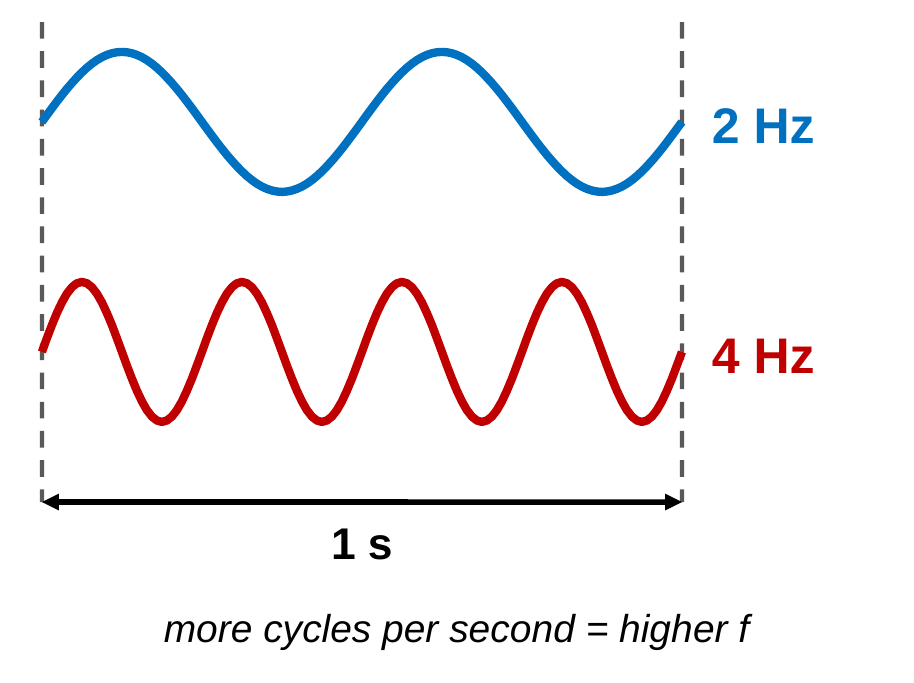
Frequency (f) is the number of cycles that pass a point each second. Its unit is the hertz (Hz), and 1 Hz means one cycle per second. In one second, the top wave completes 2 cycles, so its frequency is 2 Hz. The bottom wave completes 4 cycles, so its frequency is 4 Hz.
Frequency and Period Are Inverses
f = 1 / T and T = 1 / f
- f = frequency, in hertz (Hz)
- T = period, in seconds (s)
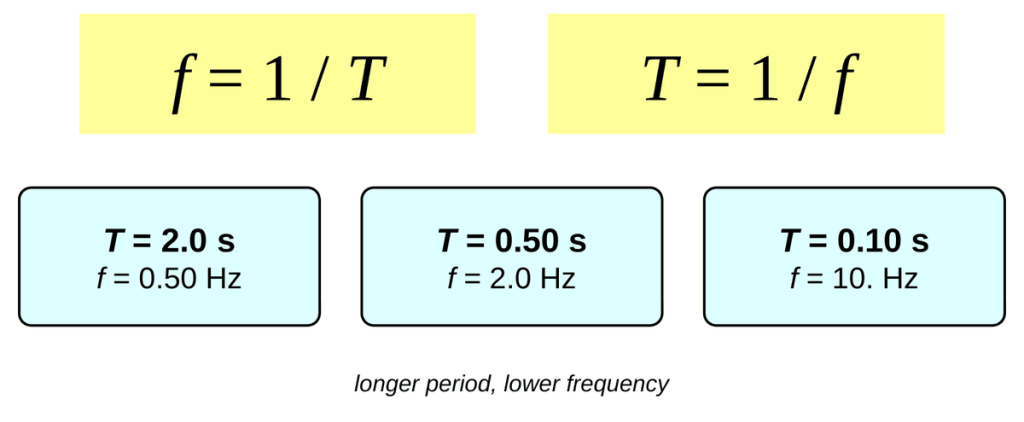
Frequency and period are inverses (reciprocals). If one cycle takes 0.50 s, then 2 cycles fit in each second, so the frequency is 2.0 Hz. A long period means a low frequency, and a short period means a high frequency. Since 1 Hz is one cycle per second, a hertz is the same as 1/s.
The Wave Equation
v = f λ
- v = wave speed, in meters per second (m/s)
- f = frequency, in hertz (Hz)
- λ = wavelength, in meters (m)
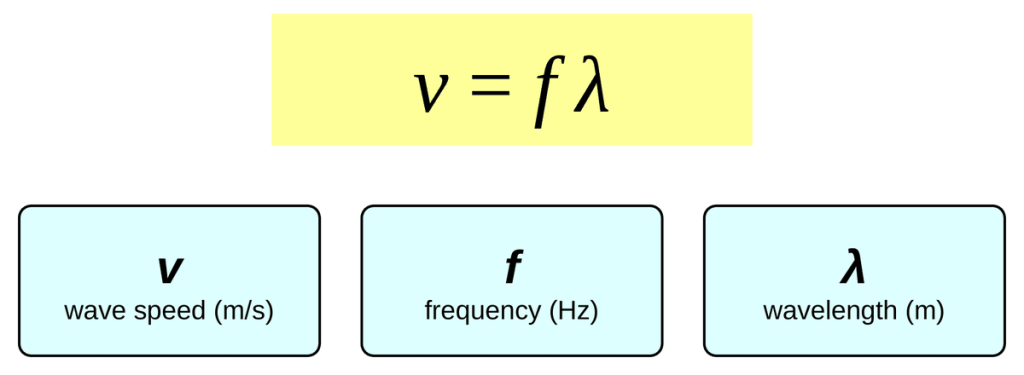
The wave equation connects how fast a wave travels to how often it repeats and how long each cycle is. Check the units: hertz is 1/s, so Hz × m = m/s, which is a speed.
Why v = f λ
- In time T, the wave moves λ
- v = d / t = λ / T
- 1/T = f, so v = f λ
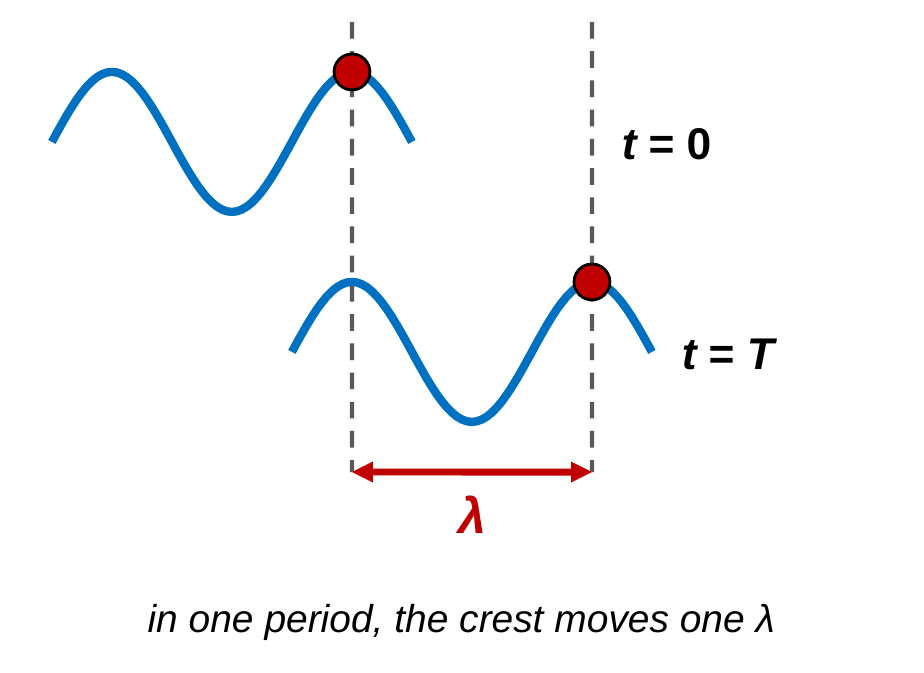
Follow one crest (the red dot). In one period, the next crest takes its place, which means the wave has moved forward exactly one wavelength. Speed is distance divided by time, so v = λ/T. Since 1/T is the frequency, this becomes v = fλ.
Speed Depends on the Medium
- The medium sets the speed
- Same medium, same speed
- Raise f, and λ gets shorter
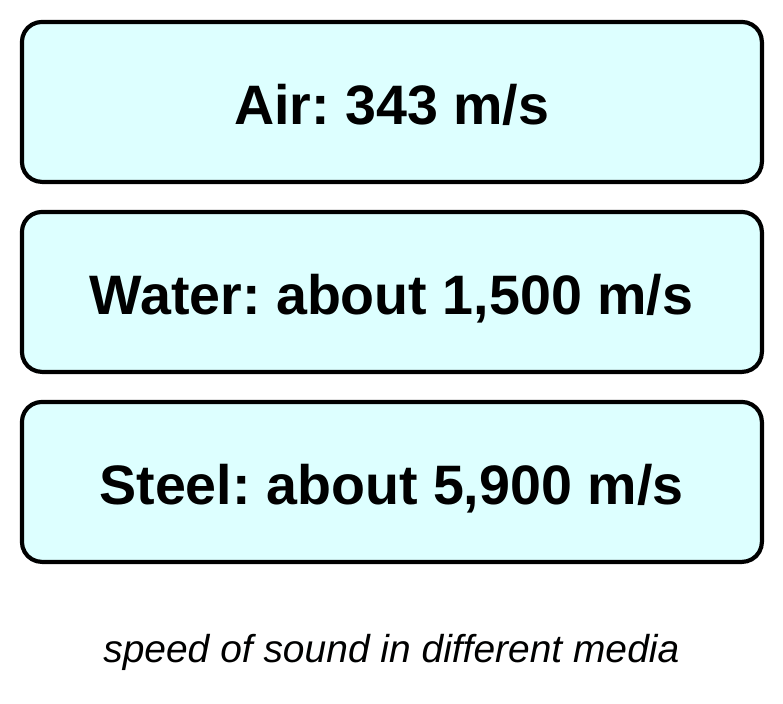
The speed of a wave depends on the medium it travels through, not on how fast the source shakes. Sound moves at about 343 m/s in room-temperature air, but much faster in water and steel. In one medium, every frequency travels at the same speed. So if you raise the frequency, v stays the same and the wavelength gets shorter to keep v = fλ true.
Solving for Any Variable
- Find speed: v = f λ
- Find frequency: f = v / λ
- Find wavelength: λ = v / f
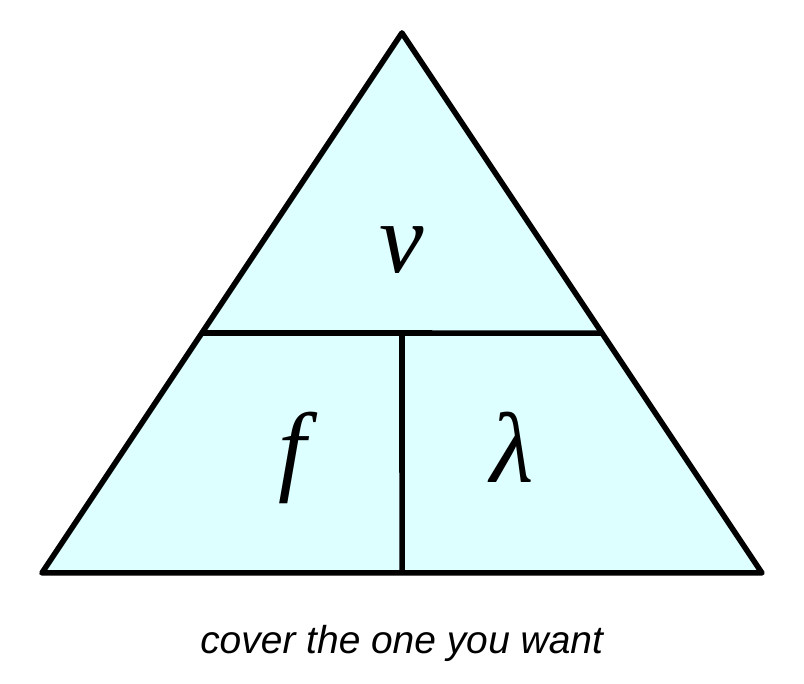
Rearrange v = fλ to solve for whatever the problem asks for. To find frequency, divide both sides by λ. To find wavelength, divide both sides by f. The triangle is a shortcut: cover the quantity you want, and what’s left shows the operation.
Worked Examples
Try each problem on your own first, then check your work against the solution.
Example 1: Bobbing Buoy
A buoy bobs up and down once every 4.0 s as waves pass. What is the frequency of the waves?
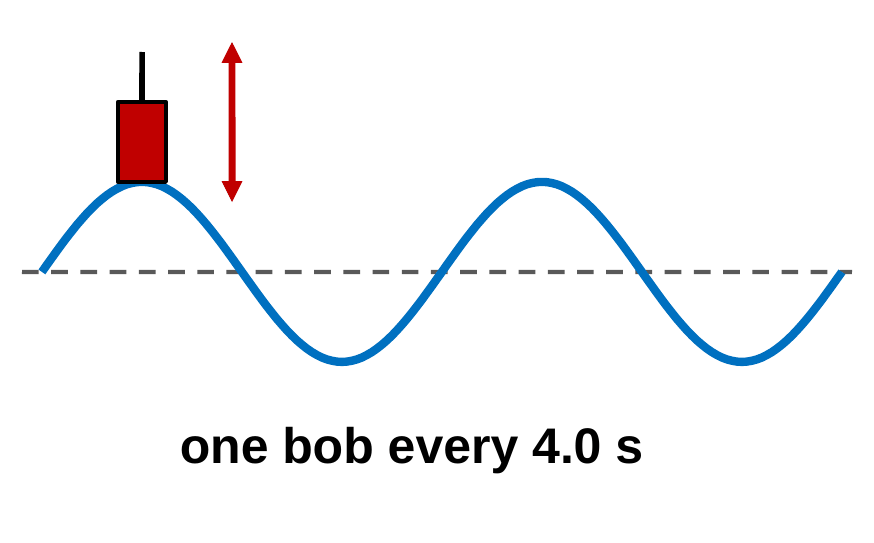
- Knowns: T = 4.0 s
- Equation: f = 1/T
- Substitute: f = 1 / 4.0 s
- Answer: f = 0.25 Hz
Since one cycle takes 4 seconds, only a quarter of a cycle happens each second, which matches 0.25 Hz.
Example 2: Wave Speed on a Rope
You shake a rope at 2.5 Hz, and the waves have a wavelength of 1.6 m. How fast do the waves travel along the rope?
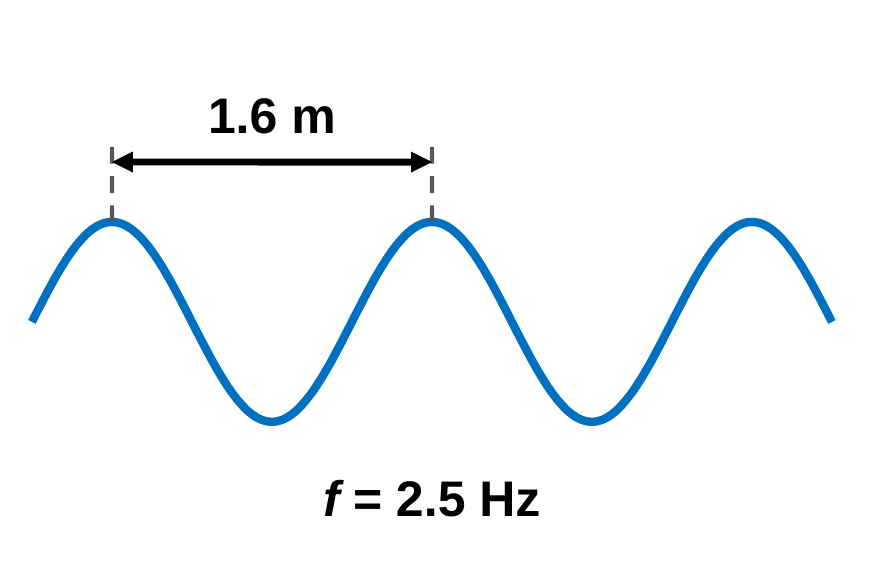
- Knowns: f = 2.5 Hz, λ = 1.6 m
- Equation: v = fλ
- Substitute: v = (2.5 Hz)(1.6 m) = (2.5 1/s)(1.6 m)
- Answer: v = 4.0 m/s
Example 3: Wavelength of a Sound
A speaker plays a note at 686 Hz. Sound travels through the air at 343 m/s. What is the wavelength of the sound?
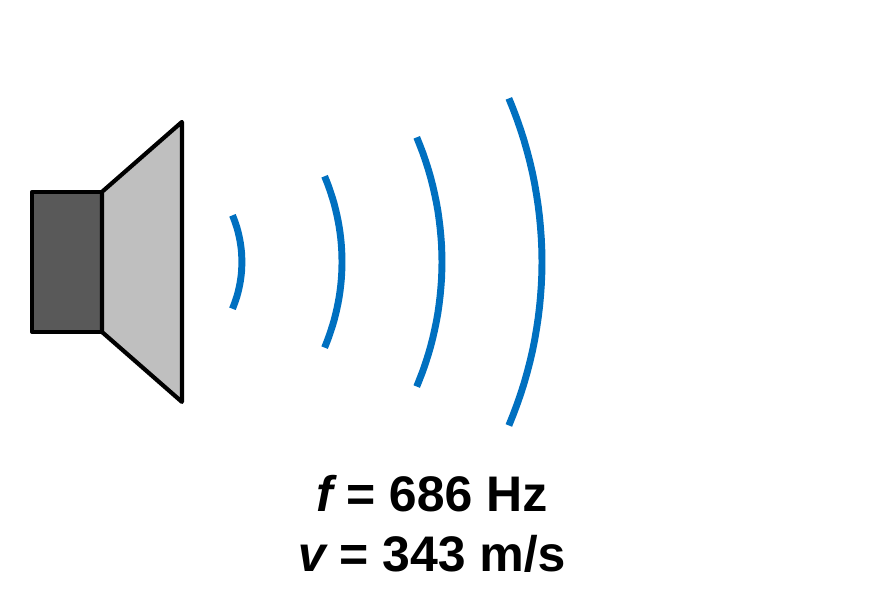
- Knowns: f = 686 Hz, v = 343 m/s
- Equation: v = fλ, so λ = v/f
- Substitute: λ = (343 m/s) / (686 Hz). Hz is 1/s, so the seconds cancel, leaving meters.
- Answer: λ = 0.500 m
Example 4: Ocean Waves
Ocean waves travel toward a pier at 6.0 m/s. The crests are 12 m apart. Find the frequency and the period of the waves.
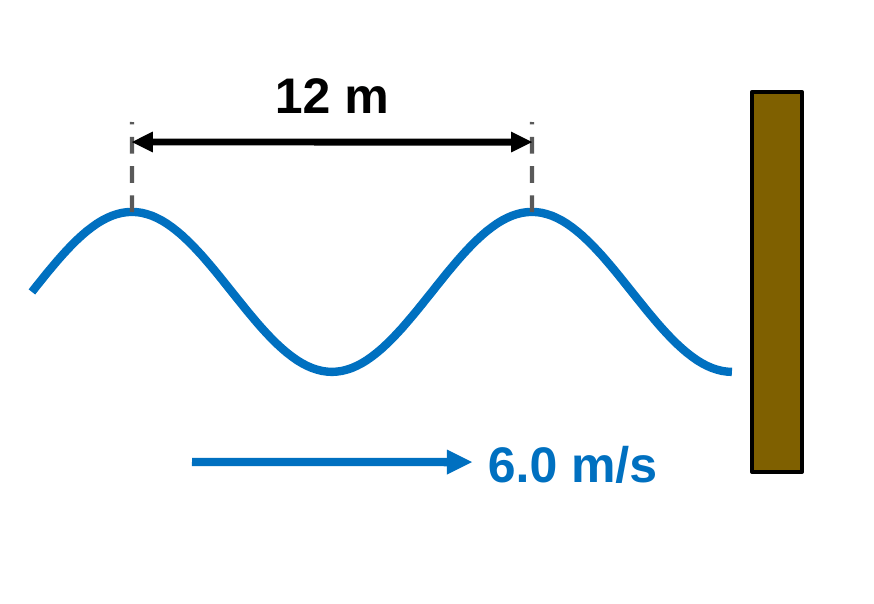
- Knowns: v = 6.0 m/s, λ = 12 m
- Frequency equation: f = v/λ
- Substitute: f = (6.0 m/s) / (12 m) = 0.50 Hz
- Period: T = 1/f = 1 / 0.50 Hz = 2.0 s
A crest hits the pier every 2.0 seconds.
Big Ideas
- Period T: seconds per cycle
- Frequency f: cycles per second (Hz)
- f = 1/T and v = f λ
- The medium sets the wave speed
Back to the essential question: a wave travels one wavelength every period, so its speed is v = fλ. The speed is set by the medium, so if the frequency changes, the wavelength changes to match. Next up, we’ll see what happens when two waves run into each other in Interference.

