
The video lesson for this topic is coming soon.
Essential Question
Why do you see yourself in a mirror?
You look in a mirror every day, but where is the person you see? By the end of this lesson, you should be able to use the law of reflection, tell specular and diffuse reflection apart, and draw a ray diagram that locates the image in a plane mirror.
The Law of Reflection
- Angle in = angle out
- θi = θr
- Both measured from the normal
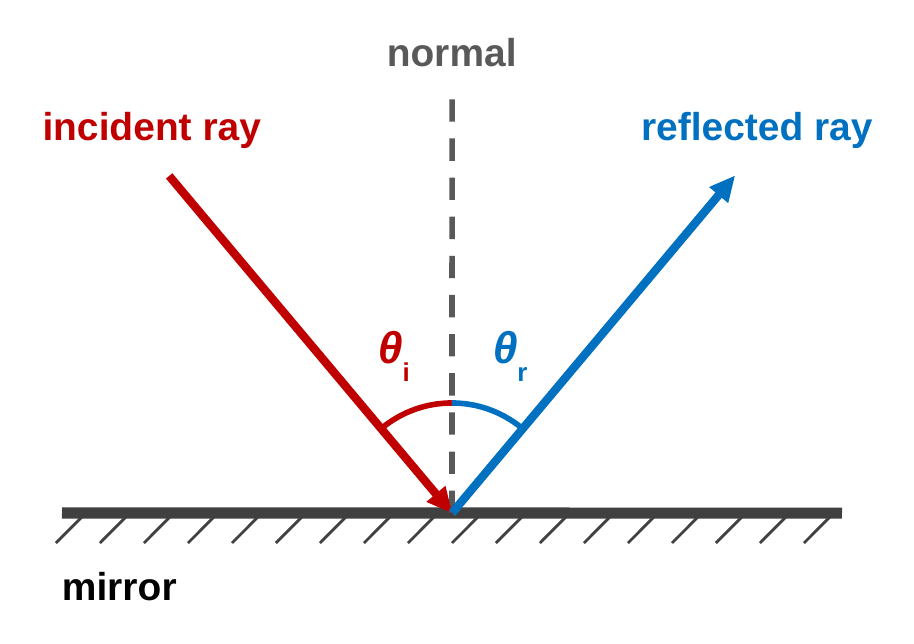
When light bounces off a surface, the angle of incidence (θi, the incoming ray) equals the angle of reflection (θr, the outgoing ray). Both angles are measured from the normal, an imaginary line perpendicular to the surface at the point where the light hits. This rule is called the law of reflection.
The Normal Line
- Line at 90° to the surface
- Draw it dashed
- Measure from it, not the mirror
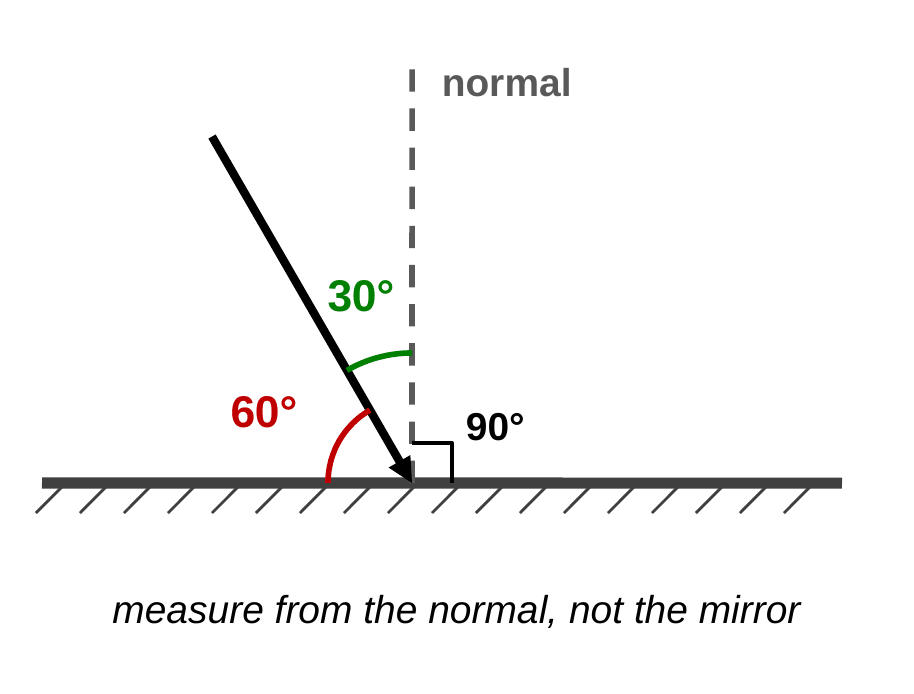
The normal is an imaginary line drawn perpendicular (at 90°) to a surface at the point where a ray hits it. We draw it as a dashed line because it isn’t a real ray of light. In this picture, the ray makes a 30° angle with the normal and a 60° angle with the mirror’s surface. The angle of incidence is the 30° angle. Always measure from the normal.
Specular vs. Diffuse Reflection
- Smooth surface: rays stay parallel
- Rough surface: rays scatter
- Mirror vs. paper
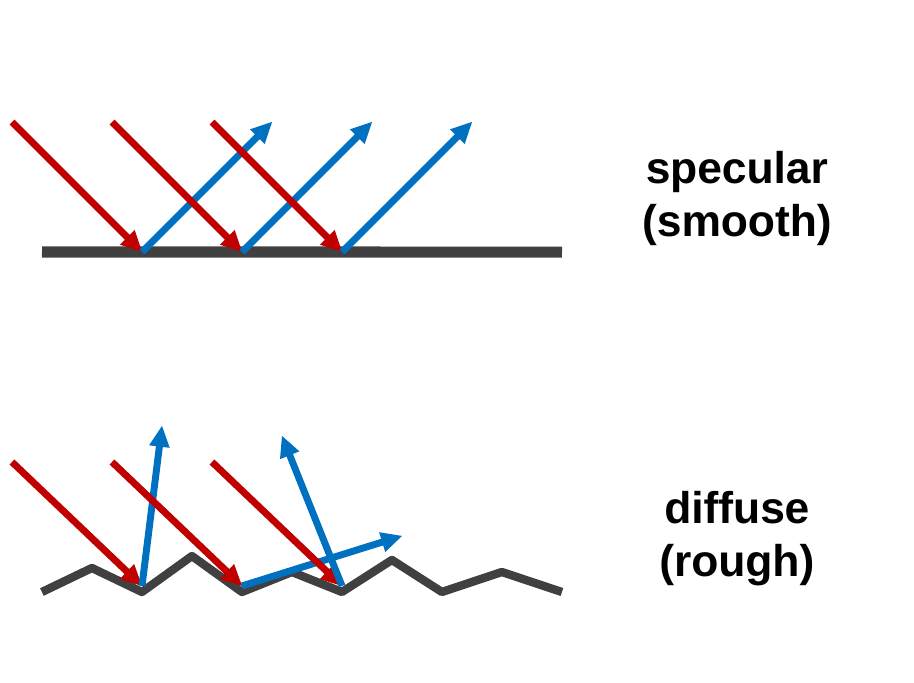
On a smooth surface like a mirror or still water, parallel rays reflect as parallel rays. This is specular reflection, and it makes a clear image. On a rough surface like paper or a wall, each tiny bump faces a different way, so parallel rays scatter in all directions. This is diffuse reflection. Every ray still obeys the law of reflection, but the normals point in different directions. Diffuse reflection is why you can see a piece of paper from anywhere in the room, but you can’t see your reflection in it.
Images in a Plane Mirror
- Image appears behind the mirror
- Same size, same distance
- Virtual: no light really goes there
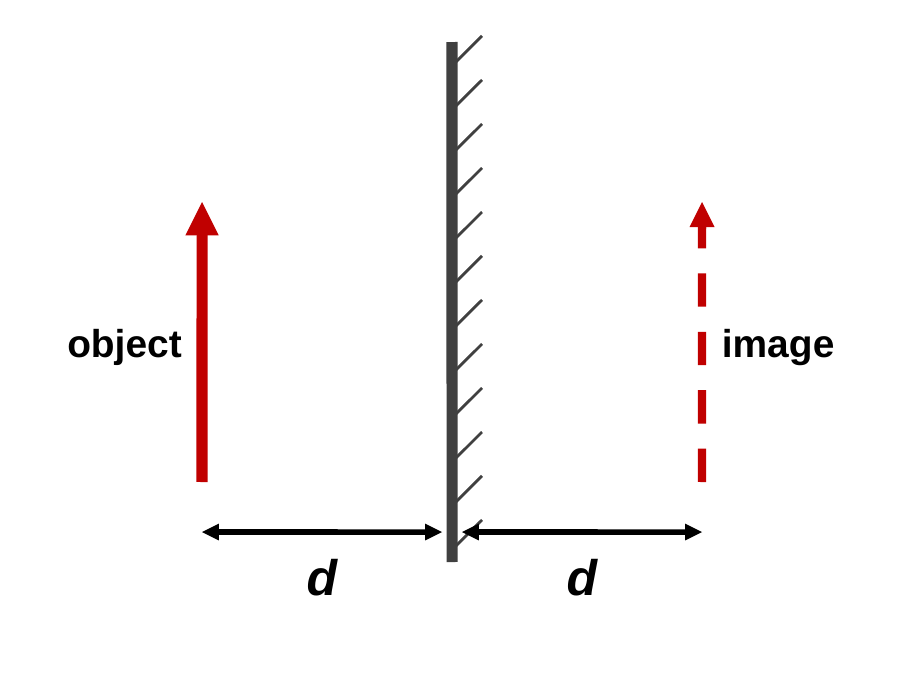
A flat mirror is called a plane mirror. The image it makes appears to be behind the mirror. It is the same size as the object, upright, and the same distance behind the mirror as the object is in front. It is a virtual image: light rays only seem to come from it. No light actually travels behind the mirror, so you could never project this image onto a screen.
Ray Diagram: Plane Mirror
- Rays leave the object
- Reflect: θi = θr
- Extend reflected rays back, dashed
- They meet at the image
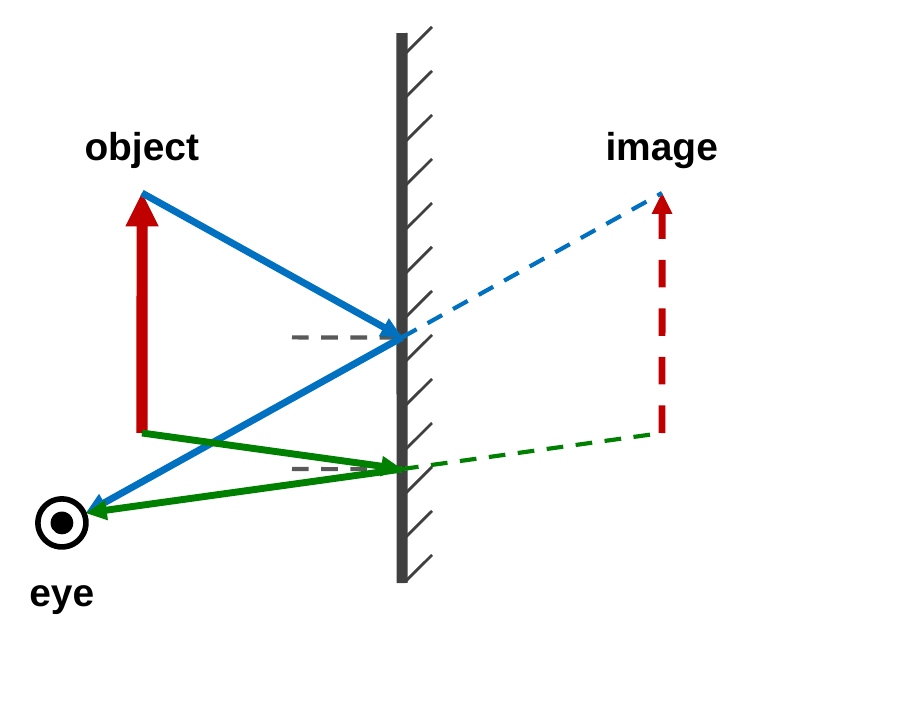
To find the image, draw rays from the object to the mirror. At each point where a ray hits, draw a dashed normal and reflect the ray so the angle of reflection equals the angle of incidence. The reflected rays spread apart and enter the eye. Your brain assumes light travels in straight lines, so it traces those rays straight back. Extend the reflected rays behind the mirror as dashed lines: they meet at the image. Since the rays don’t really go there, the image is virtual.
Worked Examples
Try each problem on your own first, then check your work against the solution.
Example 1: Angle of Reflection
A light ray strikes a plane mirror at an angle of 35° from the normal. What is the angle of reflection?
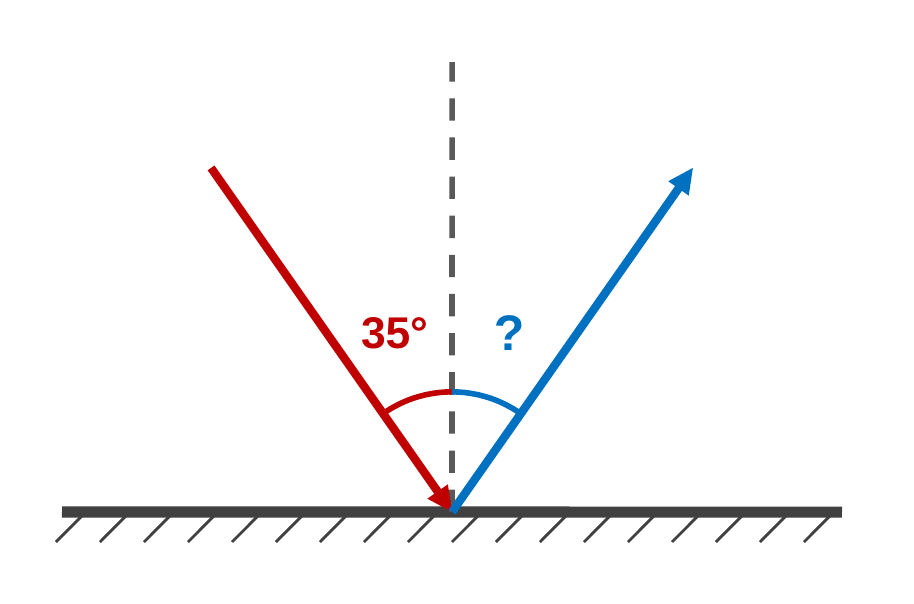
- Knowns: θi = 35°, measured from the normal
- Law of reflection: θr = θi
- Substitute: θr = 35°
- Answer: θr = 35° from the normal, on the other side of the normal
Example 2: Angle from the Surface
A ray of light makes a 25° angle with the surface of a mirror. Find the angle of incidence and the angle of reflection.
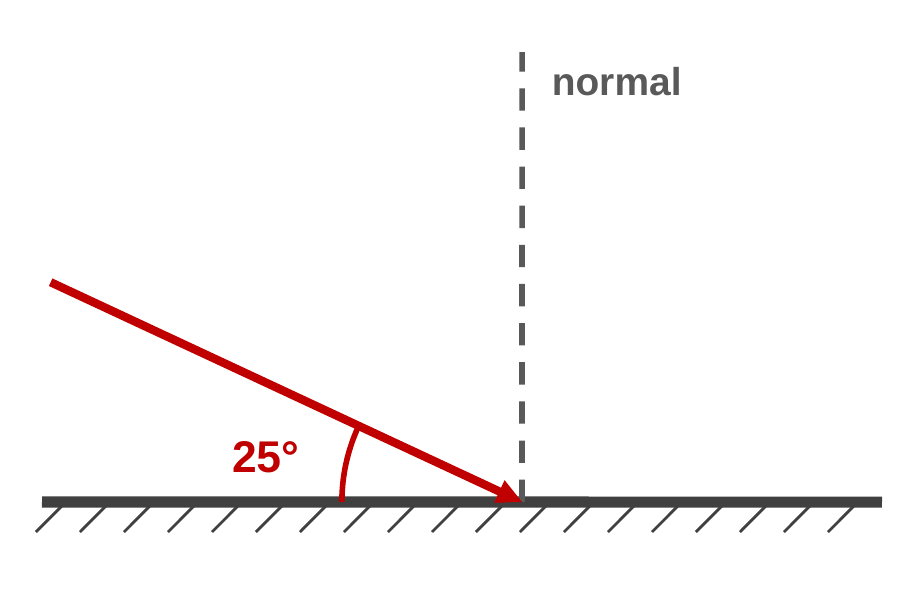
- Knowns: the ray makes 25° with the mirror surface
- Convert: the normal is 90° from the surface, so θi = 90° − 25°
- Angle of incidence: θi = 65°
- Angle of reflection: θr = θi, so θr = 65°
Common mistake: answering 25°. That angle is measured from the surface, not the normal.
Example 3: Angle Between Rays
A ray hits a mirror with an angle of incidence of 28°. What is the angle between the incident ray and the reflected ray?
- Knowns: θi = 28°
- Law of reflection: θr = θi = 28°
- Add the angles: the normal sits between the two rays, so the angle between them is θi + θr = 28° + 28°
- Answer: 56°
Example 4: Image Distance
You stand 1.5 m in front of a plane mirror. How far are you from your image?
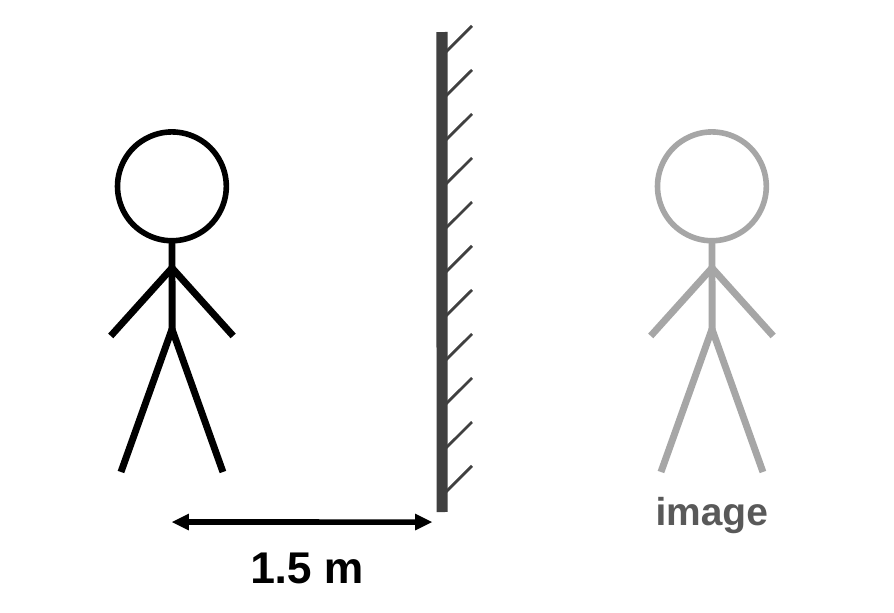
- Knowns: object distance = 1.5 m in front of the mirror
- Plane mirror rule: image distance = object distance = 1.5 m behind the mirror
- Add: distance from you to your image = 1.5 m + 1.5 m
- Answer: 3.0 m
Big Ideas
- θi = θr, measured from the normal
- Smooth: specular. Rough: diffuse
- Plane mirror image: same size, same distance
- Image is virtual, behind the mirror
Back to the essential question: light reflects off a smooth mirror with the angle of reflection equal to the angle of incidence, both measured from the normal. When you trace the reflected rays back, they seem to come from a point behind the mirror, so you see a virtual image of yourself, the same size and the same distance behind the mirror as you are in front. Next up, we’ll see what happens when light goes into a new material instead of bouncing off in Refraction.

