
The video lesson for this topic is coming soon.
Essential Question
Is light a wave or a particle?
All unit long, we’ve treated light as a wave. But one experiment, the photoelectric effect, could not be explained by waves at all. By the end of this lesson, you should be able to describe the photoelectric effect, calculate photon energy with E = hf, and explain wave-particle duality.
Light Acts Like a Wave
- Interference: bright and dark bands
- Diffraction: spreads past edges
- Refraction: bends in new materials
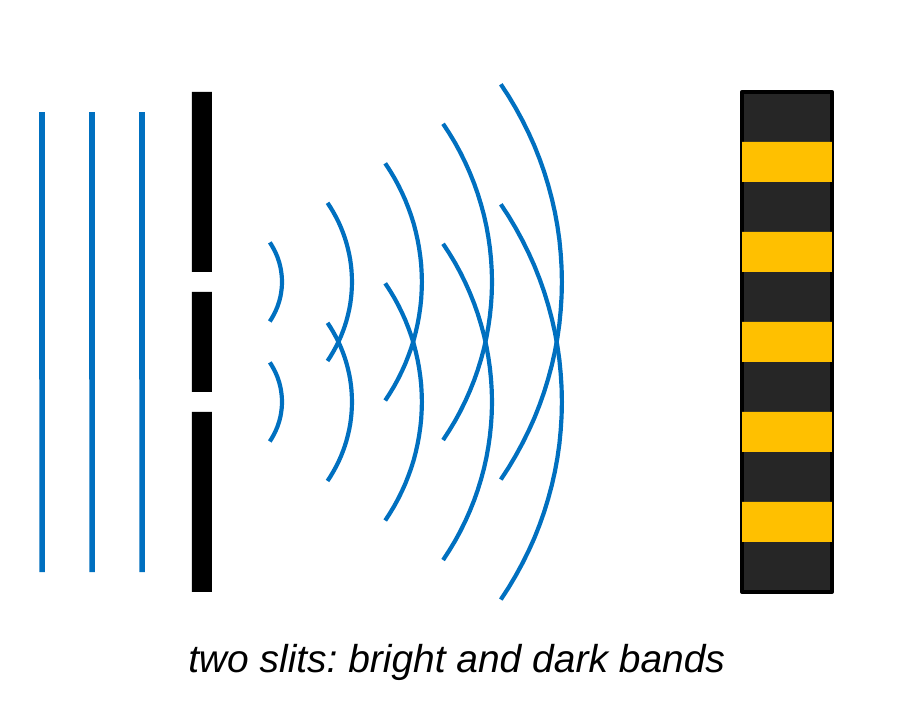
Light shows all the behaviors of a wave. When light passes through two narrow slits, the waves spreading from each slit overlap and interfere. Where crest meets crest, you get bright bands, and where crest meets trough, you get dark bands. Light also diffracts (spreads out as it passes edges and openings) and refracts (bends when it changes speed). For a long time, this convinced scientists that light was simply a wave.
The Photoelectric Effect
- Light shines on a metal
- Electrons get knocked out
- Used in solar cells and sensors
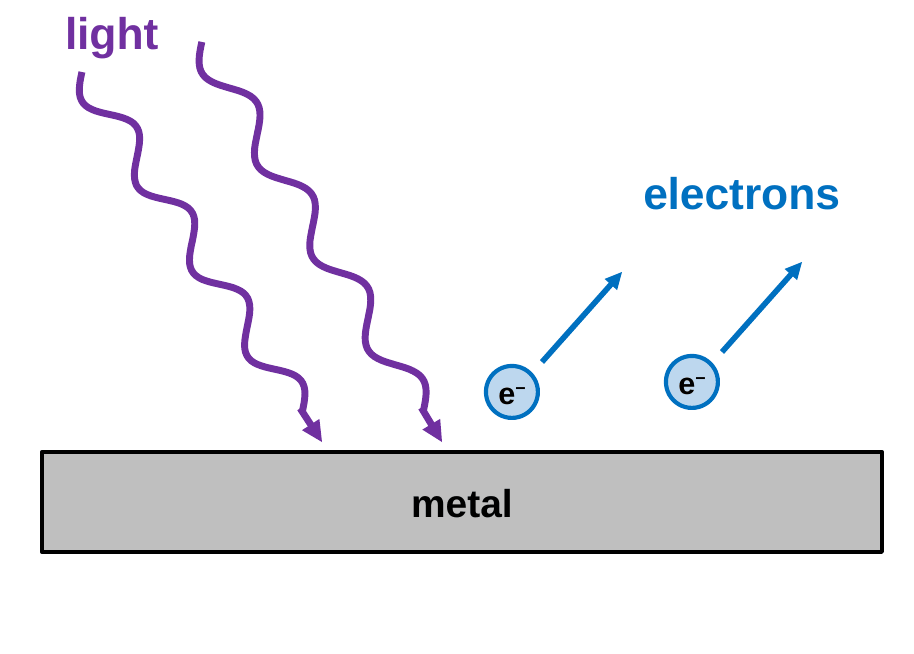
When light shines on a metal surface, it can knock electrons right out of the metal. This is called the photoelectric effect. It’s how solar panels turn sunlight into electricity, and how light sensors in automatic doors and cameras work. The surprise came when scientists looked closely at which light could do this.
The Puzzle: Frequency Matters
- Needs a minimum frequency
- Bright red light: no electrons
- Dim UV light: electrons fly out
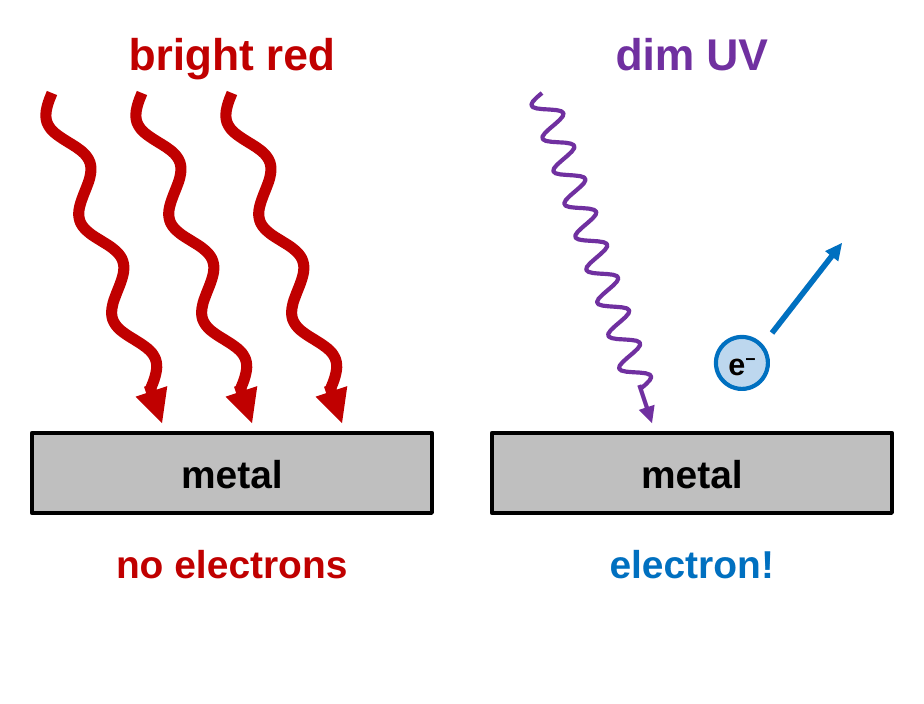
Here’s what scientists found. Below a certain threshold frequency, no electrons come out, no matter how bright the light is. Even an extremely bright red light frees zero electrons from many metals. But a dim ultraviolet light, above the threshold frequency, knocks electrons out immediately. If light were only a wave, a bright enough wave should eventually deliver enough energy to free electrons. That’s not what happens.
Photons: Light in Packets
E = h f
- E = energy of one photon, in joules (J)
- h = Planck’s constant, 6.63 × 10⁻³⁴ J·s
- f = frequency of the light, in hertz (Hz)
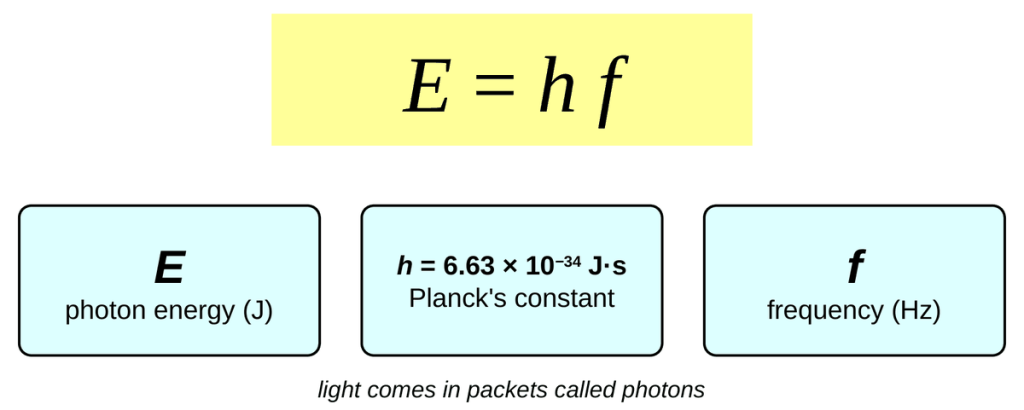
Einstein’s explanation was that light energy comes in tiny packets called photons. The energy of each photon depends only on the light’s frequency: E = hf. One photon gives all its energy to one electron. If a single photon doesn’t have enough energy to free an electron, the electron stays put, no matter how many photons arrive. Notice that h is incredibly small, so a single photon carries a tiny amount of energy.
Brightness vs. Frequency
- Brightness: number of photons
- Frequency: energy per photon
- Each photon needs enough energy
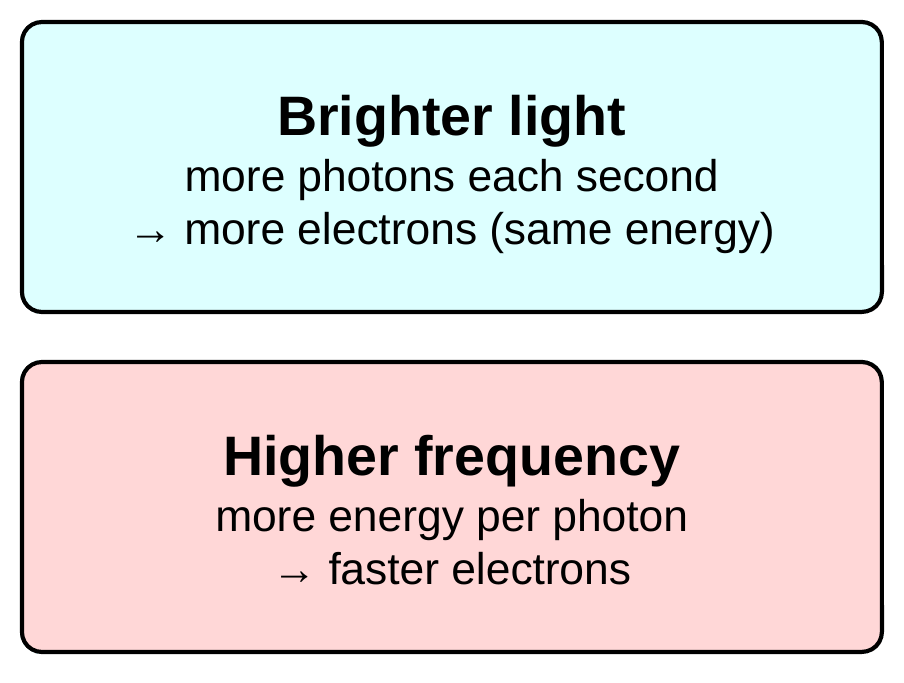
The photon model explains every result. Brightness is the number of photons arriving each second. Brighter light sends more photons, so if they have enough energy, more electrons come out, but each electron gets the same energy. Frequency sets the energy of each photon. Raising the frequency gives each photon more energy, so the freed electrons fly out faster. And if each photon is below the threshold energy, brightness doesn’t matter at all.
Wave-Particle Duality
- Light travels like a wave
- Light interacts like a particle
- We need both models
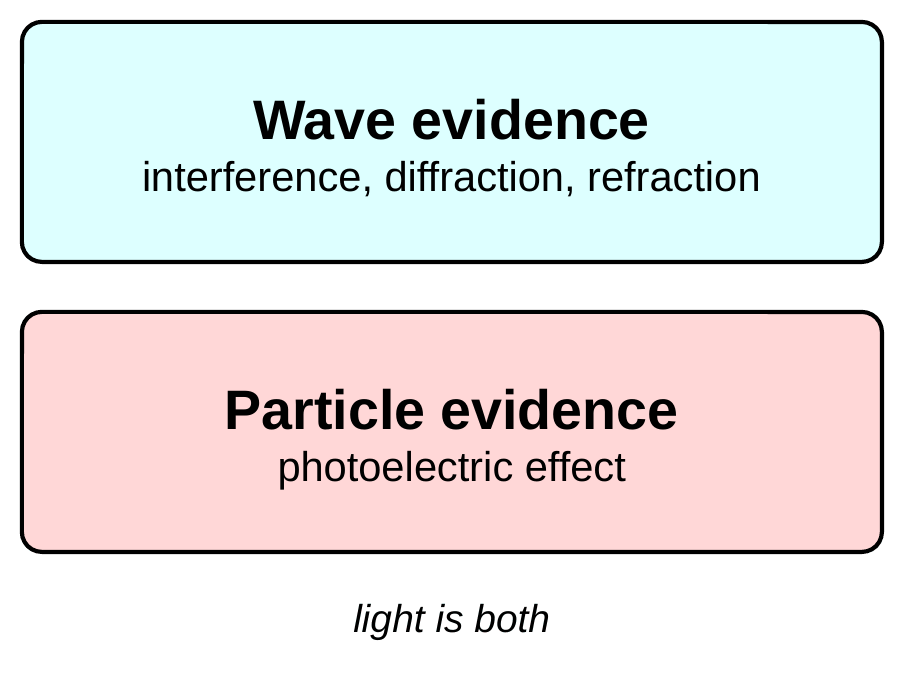
So is light a wave or a particle? Both. Light travels from place to place like a wave, which is why it interferes, diffracts, and refracts. But when it interacts with matter, like knocking electrons out of a metal, it acts like a stream of particles (photons). This idea is called wave-particle duality. Neither model alone explains everything, so physicists use whichever model fits the situation.
Worked Examples
Try each problem on your own first, then check your work against the solution.
Example 1: Energy of a Photon
Green light has a frequency of 6.00 × 10¹⁴ Hz. What is the energy of one photon of green light?
- Knowns: f = 6.00 × 10¹⁴ Hz, h = 6.63 × 10⁻³⁴ J·s
- Equation: E = hf
- Substitute: E = (6.63 × 10⁻³⁴ J·s)(6.00 × 10¹⁴ Hz). Hz is 1/s, so the seconds cancel, leaving joules.
- Answer: E = 3.98 × 10⁻¹⁹ J
Example 2: Photon from Wavelength
Ultraviolet light has a wavelength of 2.50 × 10⁻⁷ m. What is the energy of one UV photon?
- Knowns: λ = 2.50 × 10⁻⁷ m, c = 3.00 × 10⁸ m/s, h = 6.63 × 10⁻³⁴ J·s
- Frequency first: f = c/λ = (3.00 × 10⁸ m/s) / (2.50 × 10⁻⁷ m) = 1.20 × 10¹⁵ Hz
- Photon energy: E = hf = (6.63 × 10⁻³⁴ J·s)(1.20 × 10¹⁵ Hz)
- Answer: E = 7.96 × 10⁻¹⁹ J
That’s about twice the energy of a green photon, which is why UV can damage skin and visible light can’t.
Example 3: Will It Work?
A metal needs at least 3.50 × 10⁻¹⁹ J to free one electron. Will red light with a frequency of 4.50 × 10¹⁴ Hz free electrons from this metal?
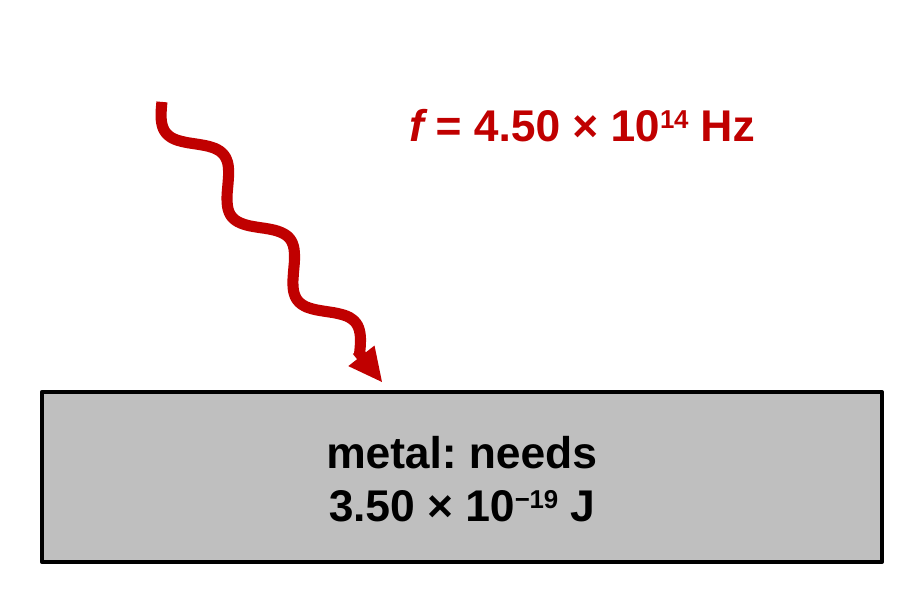
- Knowns: f = 4.50 × 10¹⁴ Hz, h = 6.63 × 10⁻³⁴ J·s, energy needed = 3.50 × 10⁻¹⁹ J
- Photon energy: E = hf = (6.63 × 10⁻³⁴ J·s)(4.50 × 10¹⁴ Hz) = 2.98 × 10⁻¹⁹ J
- Compare: 2.98 × 10⁻¹⁹ J is less than 3.50 × 10⁻¹⁹ J
- Answer: No. Each photon has too little energy, so no electrons are freed, no matter how bright the light is.
Example 4: X-Ray Frequency
One X-ray photon carries 1.99 × 10⁻¹⁵ J of energy. What is its frequency?
- Knowns: E = 1.99 × 10⁻¹⁵ J, h = 6.63 × 10⁻³⁴ J·s
- Rearrange: E = hf, so f = E/h
- Substitute: f = (1.99 × 10⁻¹⁵ J) / (6.63 × 10⁻³⁴ J·s). Joules cancel, leaving 1/s = Hz.
- Answer: f = 3.00 × 10¹⁸ Hz
That frequency sits in the X-ray part of the spectrum, which matches.
Big Ideas
- Light travels like a wave
- Light hits matter as photons
- E = hf: higher f, more energy
- Below threshold f: no electrons
Back to the essential question: light is both. It travels like a wave, which explains interference, diffraction, and refraction, but it interacts with matter like a stream of particles called photons, each with energy E = hf. That’s why only light above a threshold frequency can knock electrons out of a metal. This wraps up our unit on waves.

