
The video lesson for this topic is coming soon.
Essential Question
What happens when two waves meet?
When two balls collide, they bounce off each other. Waves behave very differently. By the end of this lesson, you should be able to add overlapping waves, explain constructive and destructive interference, and describe how noise-cancelling headphones work.
Superposition
- Waves can overlap
- Displacements add together
- Up is +, down is −
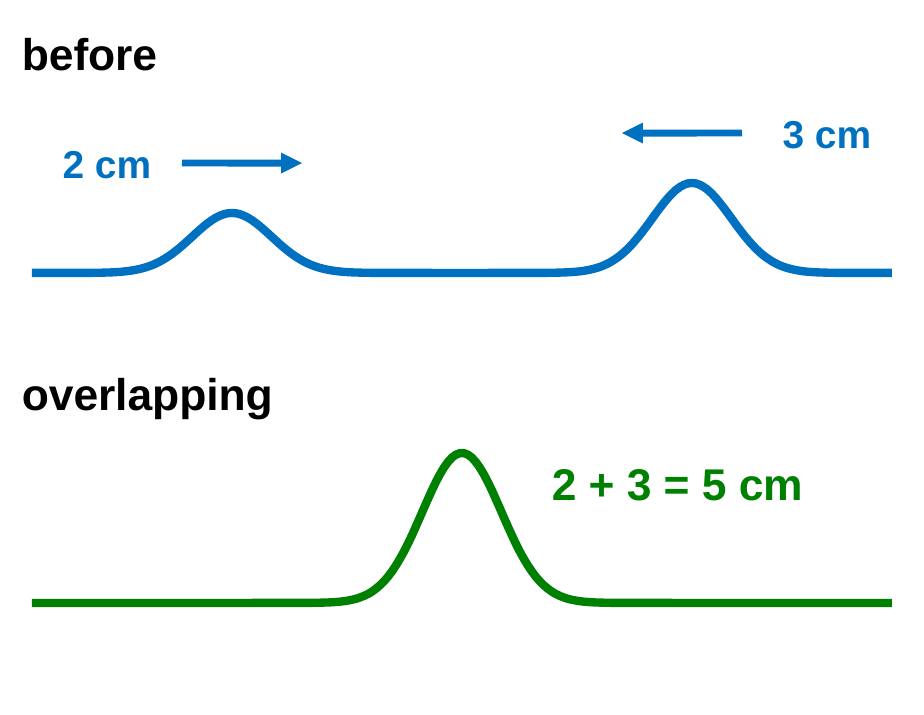
When two waves overlap in the same place, the principle of superposition says that their displacements simply add. If a 2 cm pulse and a 3 cm pulse (both upward) overlap, the rope rises 2 + 3 = 5 cm at that moment. Displacements above equilibrium count as positive and displacements below count as negative. This adding of overlapping waves is called interference.
Constructive Interference
- Crest meets crest
- Trough meets trough
- Result: a bigger wave
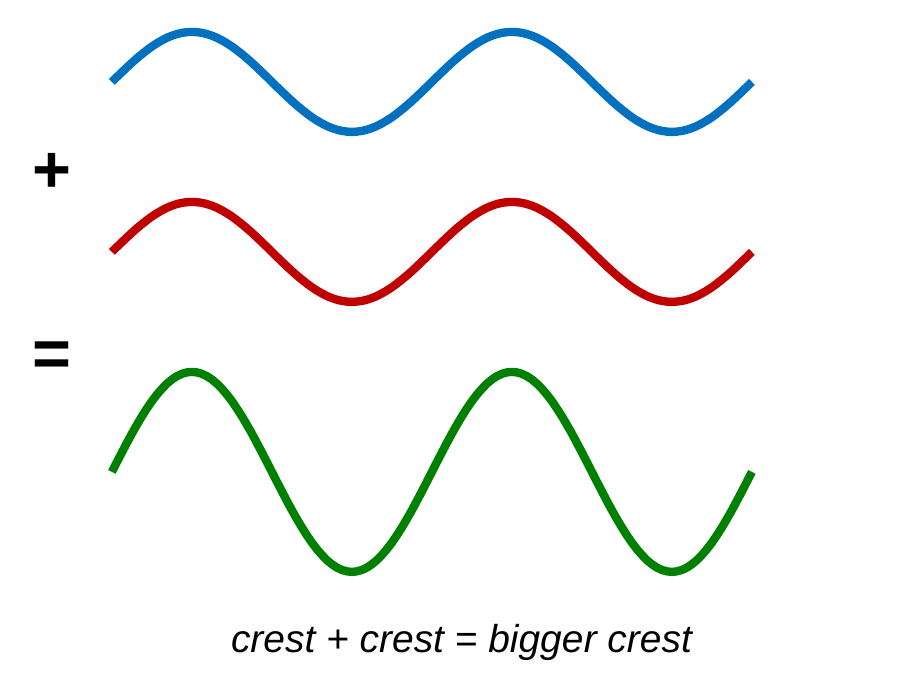
In constructive interference, the waves line up crest to crest and trough to trough. Their displacements add, so the result is a wave with a larger amplitude. Two identical waves that line up perfectly make a wave with twice the amplitude.
Destructive Interference
- Crest meets trough
- Displacements cancel
- Equal amplitudes: flat line
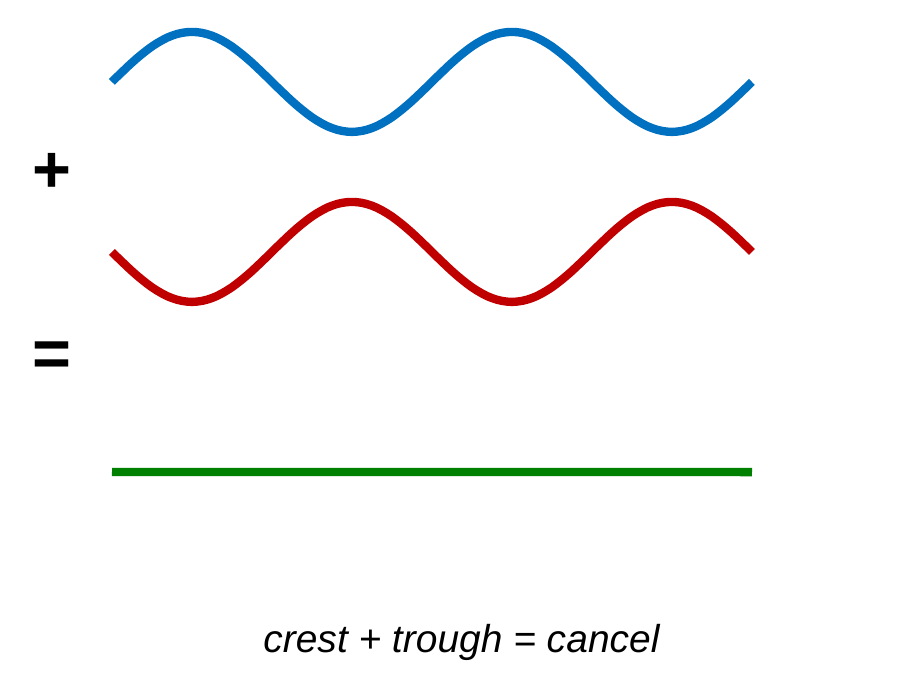
In destructive interference, the crest of one wave lines up with the trough of the other. One displacement is positive and the other is negative, so they partly or completely cancel. If the two waves have equal amplitudes, they cancel completely and the medium stays flat where they overlap.
Waves Pass Through Each Other
- Pulses overlap, then separate
- Each keeps its shape
- Each keeps its direction
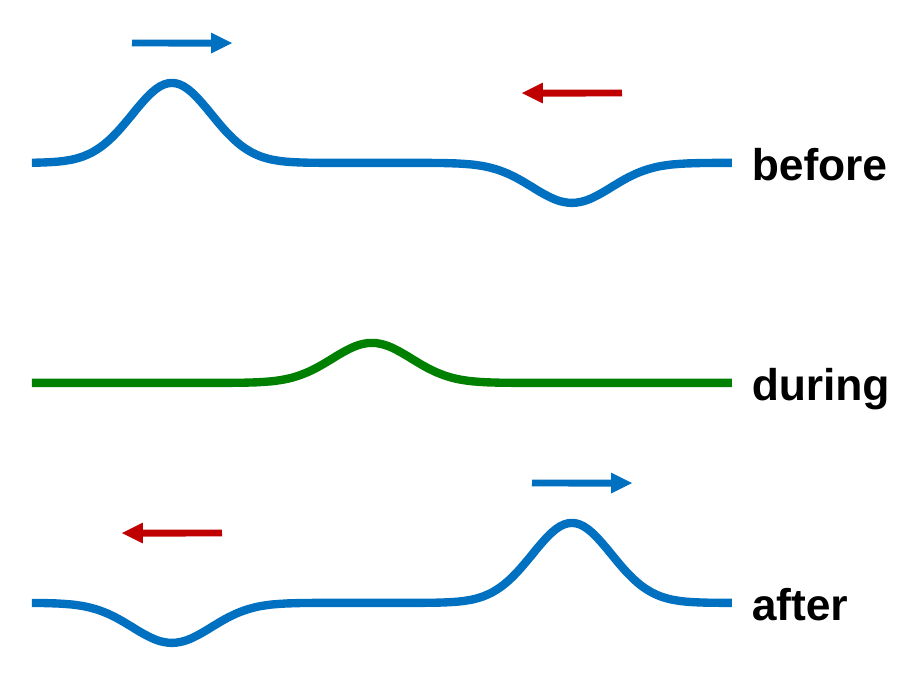
Waves are not objects, so they don’t bounce off each other. Two pulses overlap and interfere for a moment, then pass right through each other. Afterward, each pulse has exactly the same shape and size it had before, and it keeps moving in its original direction, as if the other pulse had never been there.
Noise-Cancelling Headphones
- Mic hears outside noise
- Speaker plays the flipped wave
- Destructive interference: quiet
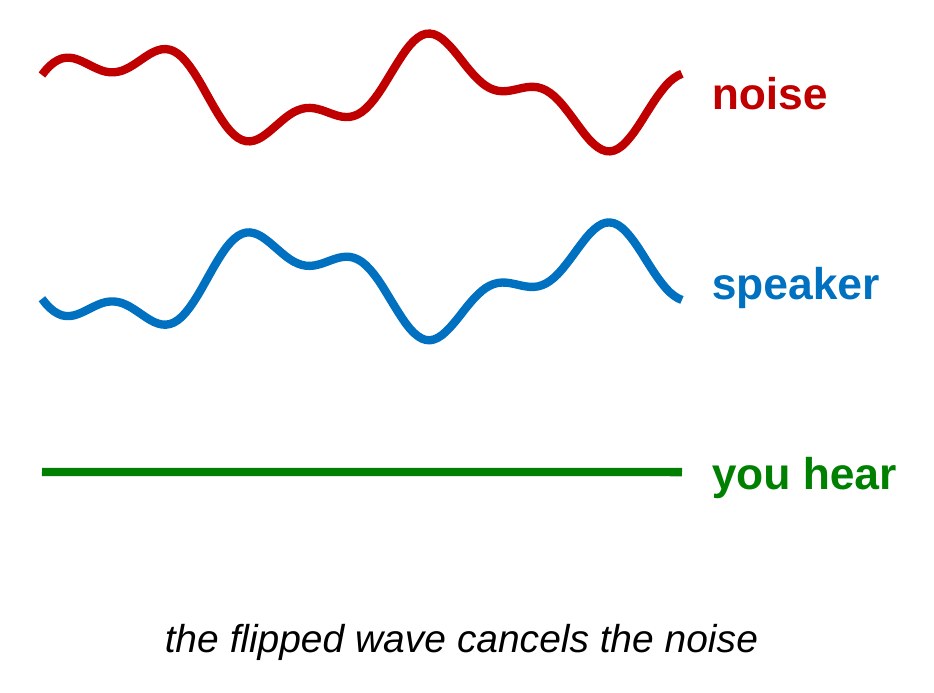
Noise-cancelling headphones use destructive interference on purpose. A tiny microphone on the outside of each ear cup picks up the incoming noise. A chip creates the exact upside-down copy of that wave, and the speaker plays it. Every crest of the noise meets a trough from the speaker, so the two cancel and you hear much less noise. Your music is added separately, so it isn’t cancelled.
Worked Examples
Try each problem on your own first, then check your work against the solution.
Example 1: Adding Two Crests
Two pulses travel toward each other on a rope. Both are crests. One is 3.0 cm tall, and the other is 5.0 cm tall. How tall is the rope when the pulses completely overlap?
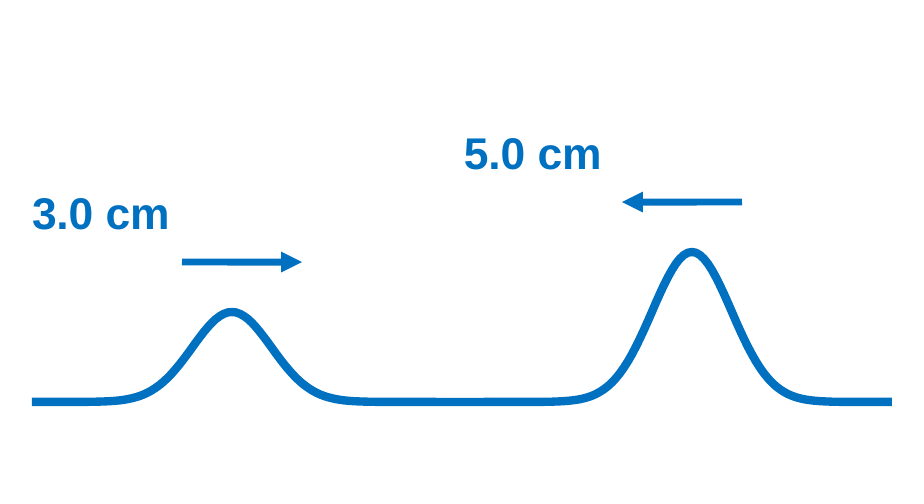
- Knowns: y1 = +3.0 cm, y2 = +5.0 cm (both crests, so both positive)
- Superposition: y = y1 + y2
- Substitute: y = (+3.0 cm) + (+5.0 cm)
- Answer: y = +8.0 cm (8.0 cm above equilibrium). This is constructive interference.
Example 2: Crest Meets Trough
A 6.0 cm crest and a 4.0 cm trough travel toward each other on a rope. What is the displacement of the rope when they completely overlap?
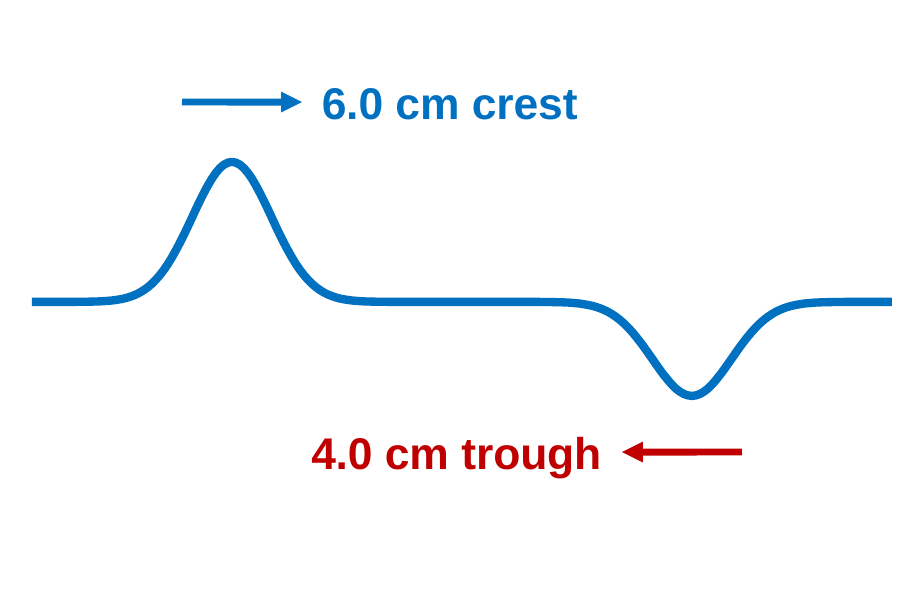
- Knowns: y1 = +6.0 cm (crest), y2 = −4.0 cm (trough)
- Superposition: y = y1 + y2
- Substitute: y = (+6.0 cm) + (−4.0 cm)
- Answer: y = +2.0 cm (2.0 cm above equilibrium). This is destructive interference, since the waves partly cancel.
Example 3: After They Pass
The 6.0 cm crest and the 4.0 cm trough from the last example pass through each other. Describe each pulse after they separate.
- Key idea: waves pass through each other without changing
- Crest: still a 6.0 cm crest, still moving in its original direction
- Trough: still a 4.0 cm trough, still moving in its original direction
- Answer: both pulses are unchanged. The 2.0 cm displacement only existed while they overlapped.
Example 4: Canceling Noise
At one instant, the noise wave at your ear has a displacement of +0.40 µm. What displacement should the headphone speaker’s wave have at that instant to cancel the noise?
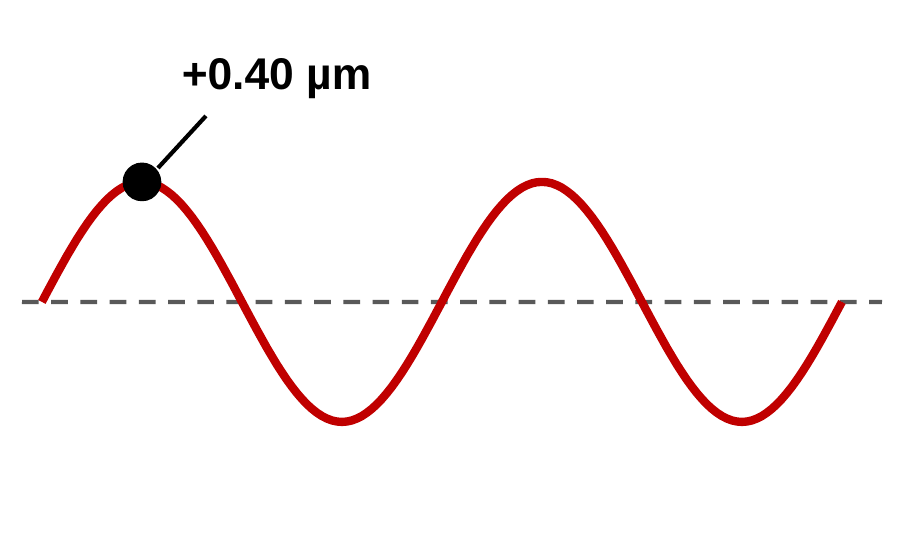
- Goal: total displacement = 0
- Superposition: ynoise + yspeaker = 0
- Rearrange: yspeaker = −ynoise = −(+0.40 µm)
- Answer: yspeaker = −0.40 µm, a trough exactly as deep as the noise crest is tall
Big Ideas
- Overlapping displacements add
- Crest + crest: constructive, bigger
- Crest + trough: destructive, cancel
- Waves pass through each other unchanged
Back to the essential question: when two waves meet, their displacements add together. Crest on crest builds a bigger wave (constructive interference), and crest on trough cancels (destructive interference). Then the waves pass through each other unchanged. Next up, we’ll see what happens when a wave interferes with its own reflection in Standing Waves.

