
The video lesson for this topic is coming soon.
Essential Question
How can a wave stand still?
Pluck a guitar string and it vibrates in a pattern that seems frozen in place, even though waves are supposed to travel. By the end of this lesson, you should be able to identify nodes and antinodes, name harmonics, and use λ = 2L/n to find wavelengths on a string.
What Is a Standing Wave?
- A wave reflects off a fixed end
- The two waves interfere
- The pattern stays in place
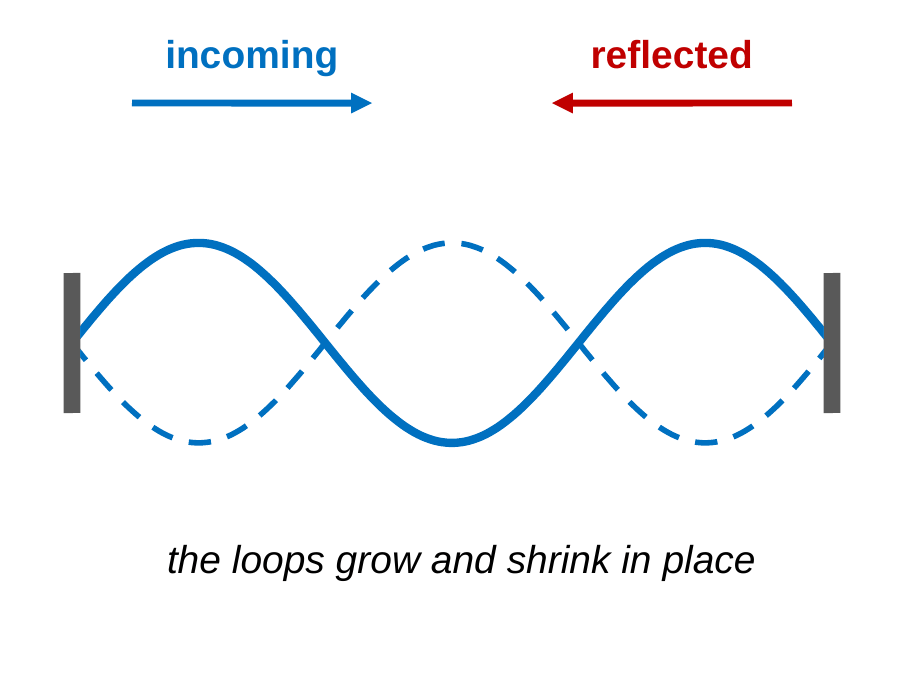
Send a wave down a string tied to a wall and it reflects back. The incoming wave and the reflected wave overlap and interfere. At just the right frequencies, they combine into a standing wave: a pattern of loops that grow and shrink in place instead of traveling down the string. The solid and dashed curves show the string half a cycle apart.
Nodes and Antinodes
- Node: never moves
- Antinode: moves the most
- Nodes: destructive
- Antinodes: constructive
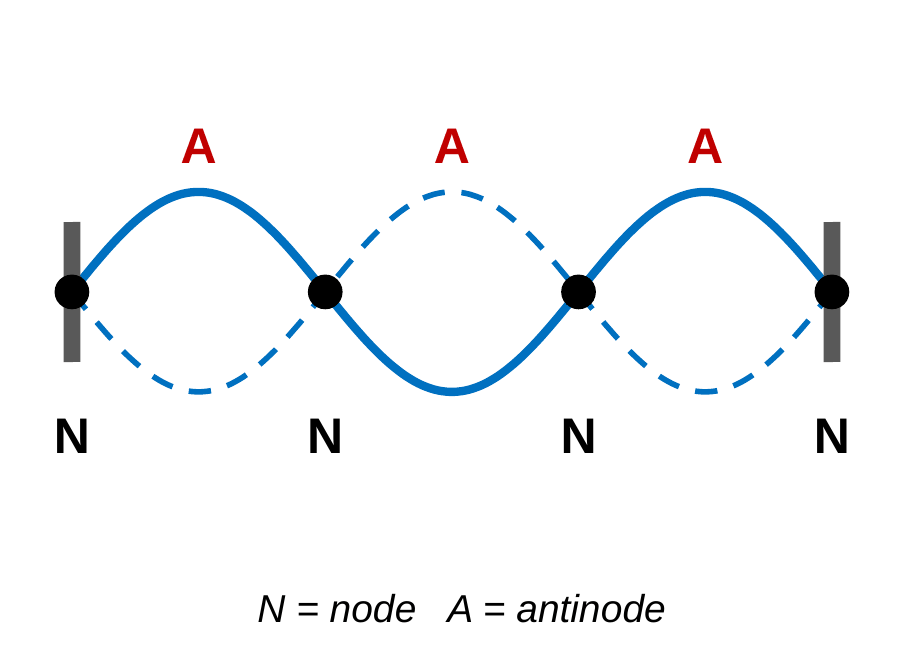
A node is a point on a standing wave that never moves. At a node, the incoming and reflected waves always cancel (destructive interference). An antinode is a point halfway between nodes that swings up and down the farthest. At an antinode, the two waves always add (constructive interference). The fixed ends of a string are always nodes.
One Loop = Half a Wavelength
- Each loop is half a wavelength
- Node to node: λ/2
- Two loops make one λ
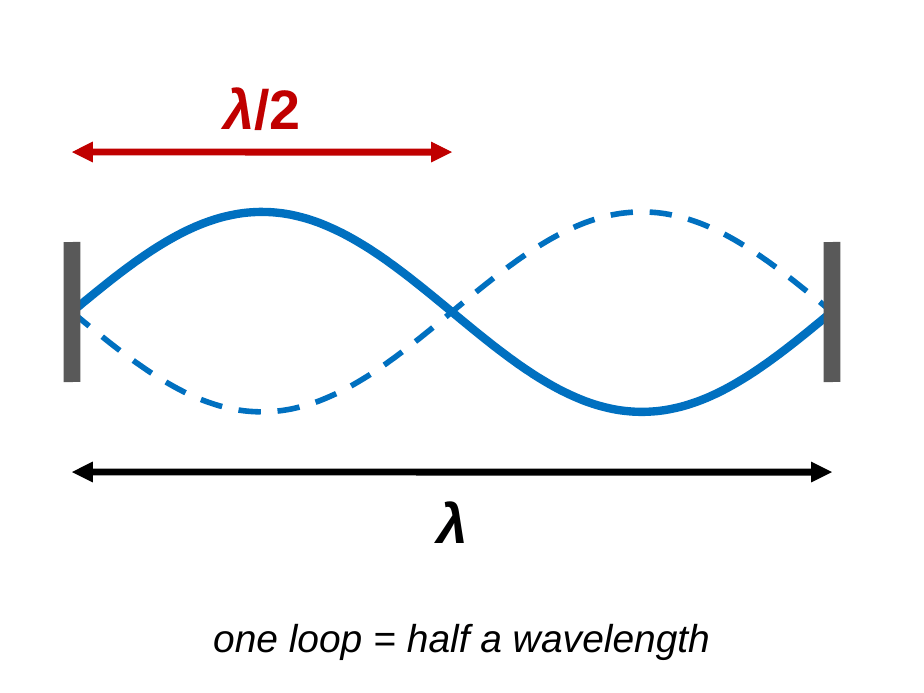
One full wavelength of a wave has a crest and a trough. A single loop of a standing wave is only the crest part (or only the trough part), so each loop is half a wavelength. The distance from one node to the next node is λ/2, and two loops together make one full wavelength.
Harmonics
- Only certain patterns fit
- Each pattern is a harmonic
- n = number of loops
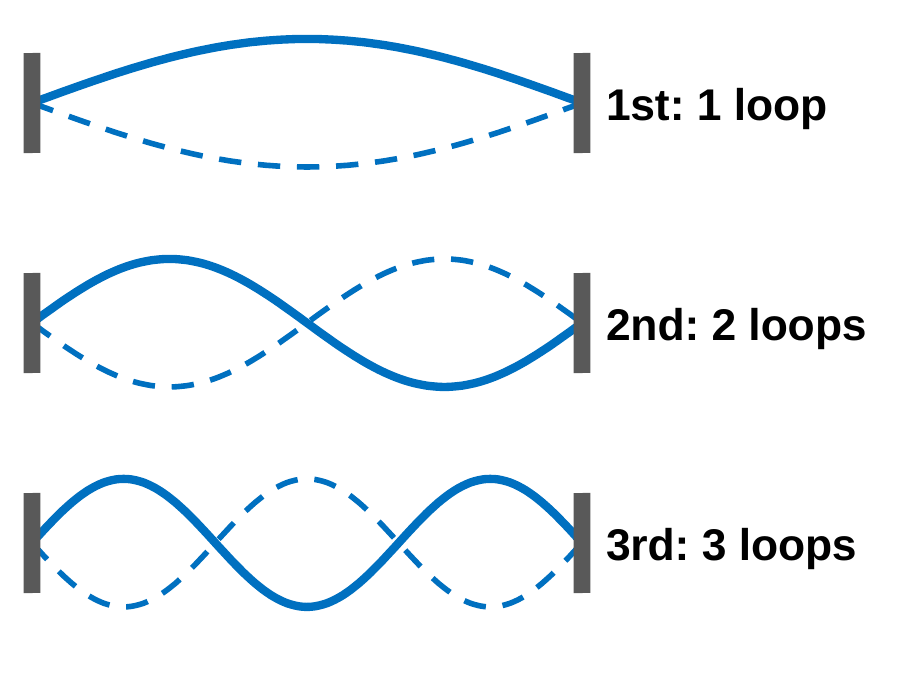
A string fixed at both ends must have a node at each end, so only patterns with a whole number of loops can form. Each allowed pattern is called a harmonic. The harmonic number n equals the number of loops: the 1st harmonic (also called the fundamental) has 1 loop, the 2nd harmonic has 2 loops, and so on.
Wavelength from String Length
λ = 2L / n
- λ = wavelength, in meters (m)
- L = length of the string, in meters (m)
- n = harmonic number (the number of loops)
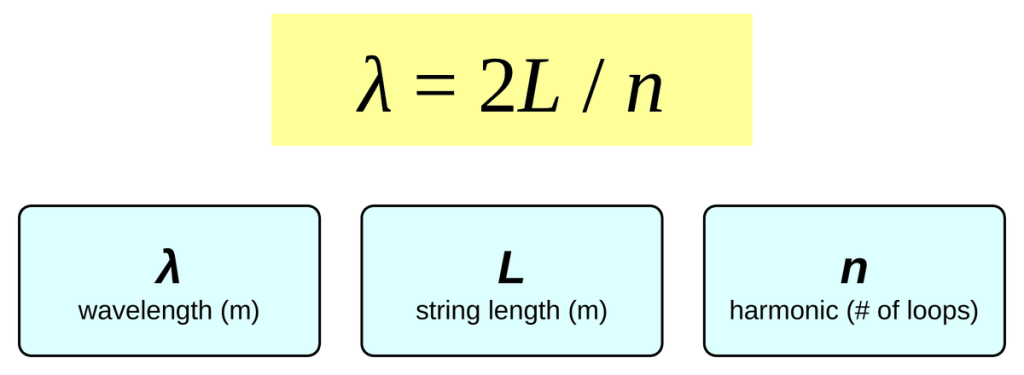
Each loop is half a wavelength, and n loops fill the whole string. So L = n(λ/2). Solving for wavelength gives λ = 2L/n. For the 1st harmonic, the wavelength is twice the length of the string.
Resonance
- Each harmonic: its own frequency
- Match it: huge waves
- Like pushing a swing
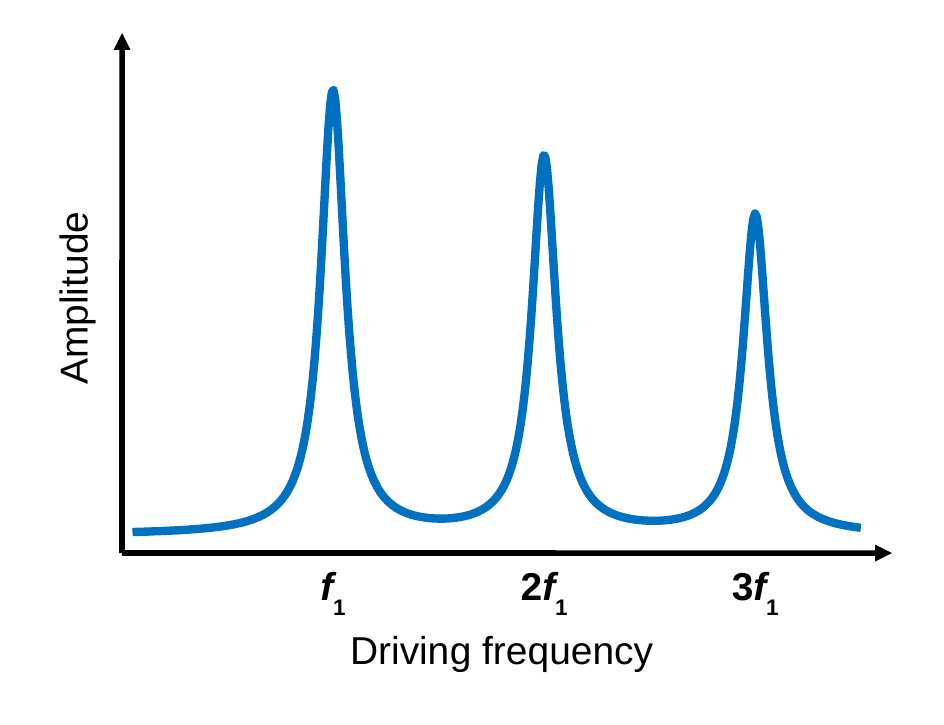
Each harmonic happens at its own frequency, called a natural frequency. If f1 is the frequency of the 1st harmonic, the others are 2f1, 3f1, and so on. When you shake the string at exactly one of these frequencies, each push adds to the wave already there and the amplitude grows huge. This is resonance. It’s the same reason a swing goes higher when you push it in rhythm. Shake at any other frequency and the string barely moves.
Worked Examples
Try each problem on your own first, then check your work against the solution.
Example 1: Counting Nodes
A string fixed at both ends vibrates in its 3rd harmonic. How many nodes and how many antinodes does it have?
- Loops: 3rd harmonic means n = 3, so there are 3 loops
- Antinodes: one antinode in the middle of each loop: 3 antinodes
- Nodes: a node at each end plus one between each pair of loops: 2 + 2
- Answer: 4 nodes and 3 antinodes. Nodes always outnumber antinodes by one on a string fixed at both ends.
Example 2: Finding Wavelength
A 1.20 m string vibrates with 3 loops. What is the wavelength of the waves on the string?
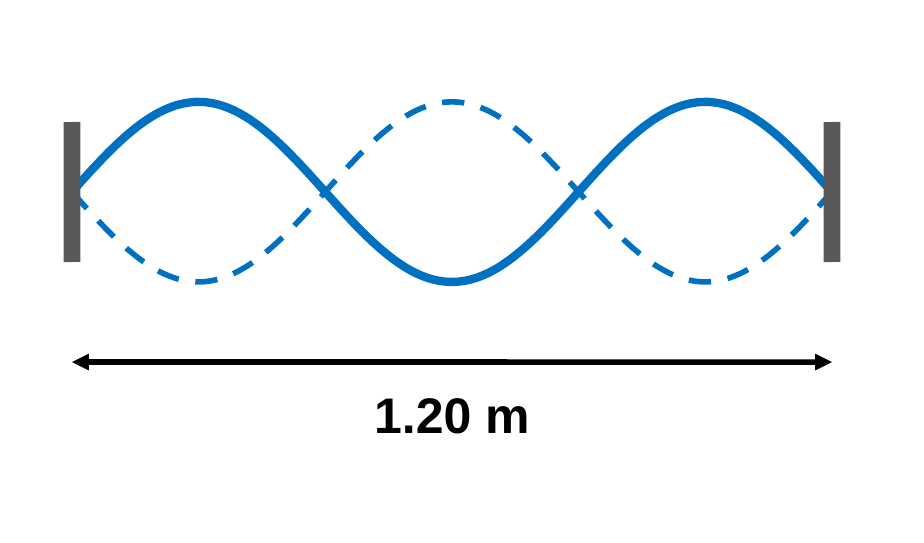
- Knowns: L = 1.20 m, n = 3 (3 loops)
- Equation: λ = 2L/n
- Substitute: λ = 2(1.20 m) / 3 = 2.40 m / 3
- Answer: λ = 0.800 m
Check: each loop is 1.20 m ÷ 3 = 0.400 m, and two loops make one wavelength, 0.800 m.
Example 3: Guitar String
A 0.650 m guitar string vibrates in its 1st harmonic at 196 Hz. What is the speed of the waves on the string?
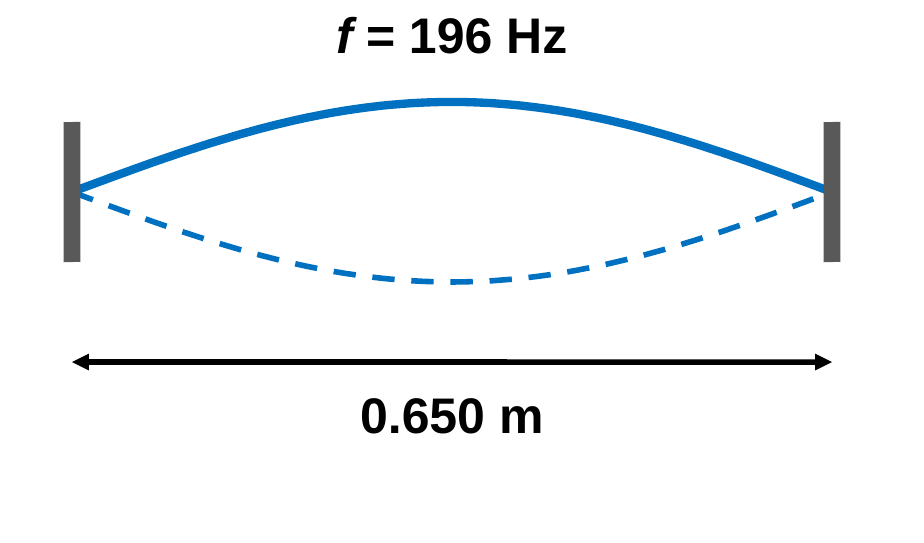
- Knowns: L = 0.650 m, n = 1, f = 196 Hz
- Wavelength: λ = 2L/n = 2(0.650 m)/1 = 1.30 m
- Wave equation: v = fλ = (196 Hz)(1.30 m) = 254.8 m/s
- Answer: v = 255 m/s (three significant figures)
Example 4: Which Harmonic?
A 2.0 m rope fixed at both ends has a standing wave with a wavelength of 0.80 m. Which harmonic is it?
- Knowns: L = 2.0 m, λ = 0.80 m
- Rearrange: λ = 2L/n, so n = 2L/λ
- Substitute: n = 2(2.0 m) / 0.80 m = 4.0 m / 0.80 m. The meters cancel.
- Answer: n = 5, so it is the 5th harmonic (5 loops)
Big Ideas
- Standing wave: a wave + its reflection
- Nodes never move; antinodes move most
- Each loop is half a wavelength
- λ = 2L/n, where n = number of loops
Back to the essential question: a wave can look like it is standing still when it interferes with its own reflection. Some points, the nodes, always cancel, and others, the antinodes, swing the most, so the pattern stays in place. Each harmonic fits a whole number of half wavelengths on the string, so λ = 2L/n. Next up, we’ll meet a whole family of waves that can travel through empty space in The Electromagnetic Spectrum.

