
The video lesson for this topic is coming soon.
Essential Question
Why does a straw look bent in a glass of water?
Put a straw in a clear glass of water and it looks broken right at the surface. The straw didn’t change, but the light coming from it did. By the end of this lesson, you should be able to explain why light bends, use the index of refraction n = c/v, and solve problems with Snell’s law.
What Is Refraction?
- New material, new speed
- The speed change bends light
- Bending happens at the boundary
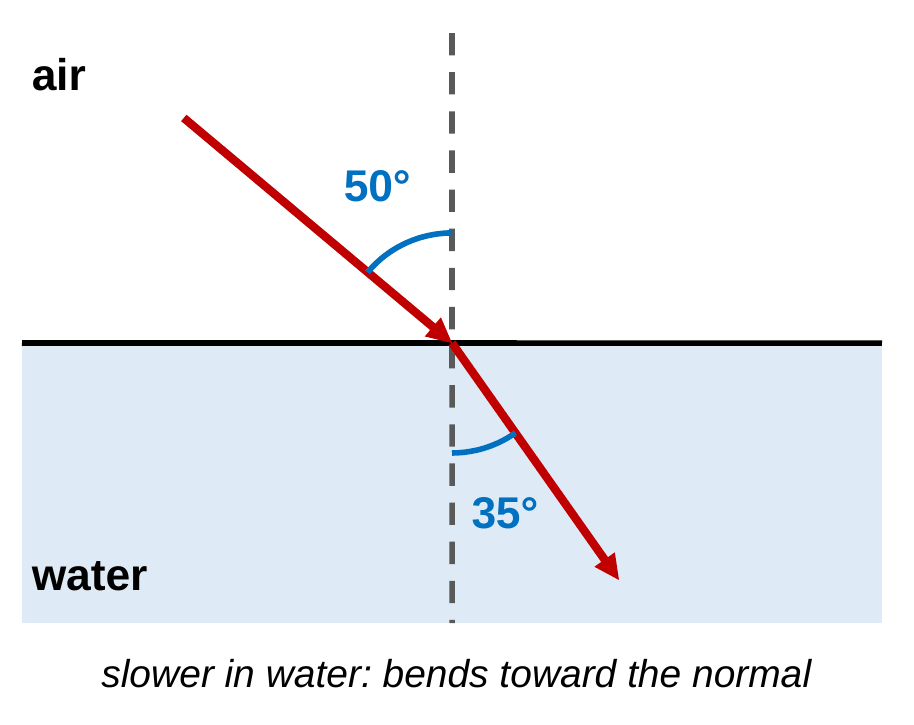
Light travels at different speeds in different materials. When light crosses the boundary into a new material at an angle, the change in speed makes it change direction. This bending is called refraction. Here, light slows down as it enters water, so it bends toward the normal: 50° from the normal in air becomes about 35° in water. Light that hits the boundary straight along the normal changes speed but does not bend.
Index of Refraction
n = c / v
- n = index of refraction (no unit)
- c = speed of light in a vacuum, 3.00 × 10⁸ m/s
- v = speed of light in the material, in m/s
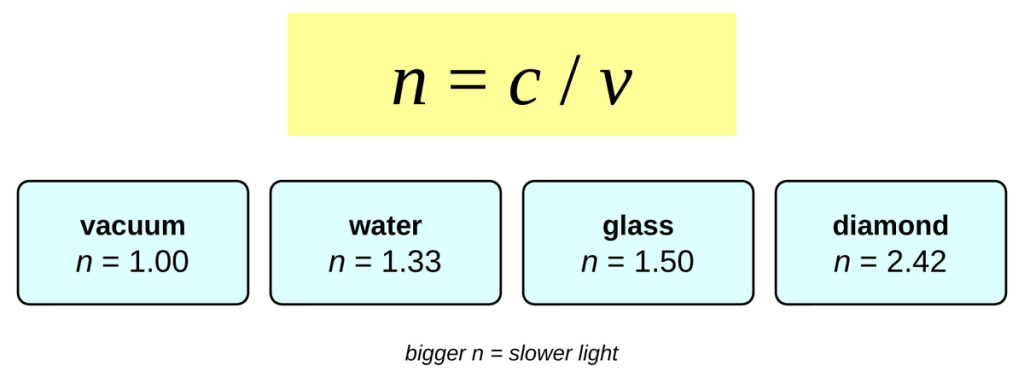
The index of refraction tells you how much a material slows light down. Water has n = 1.33, which means light is 1.33 times slower in water than in a vacuum. A bigger index means slower light. Since nothing is faster than light in a vacuum, n is never less than 1. It has no unit because it’s a ratio of two speeds.
Toward or Away from the Normal
- Slows down: toward normal
- Speeds up: away from normal
- Along the normal: no bend
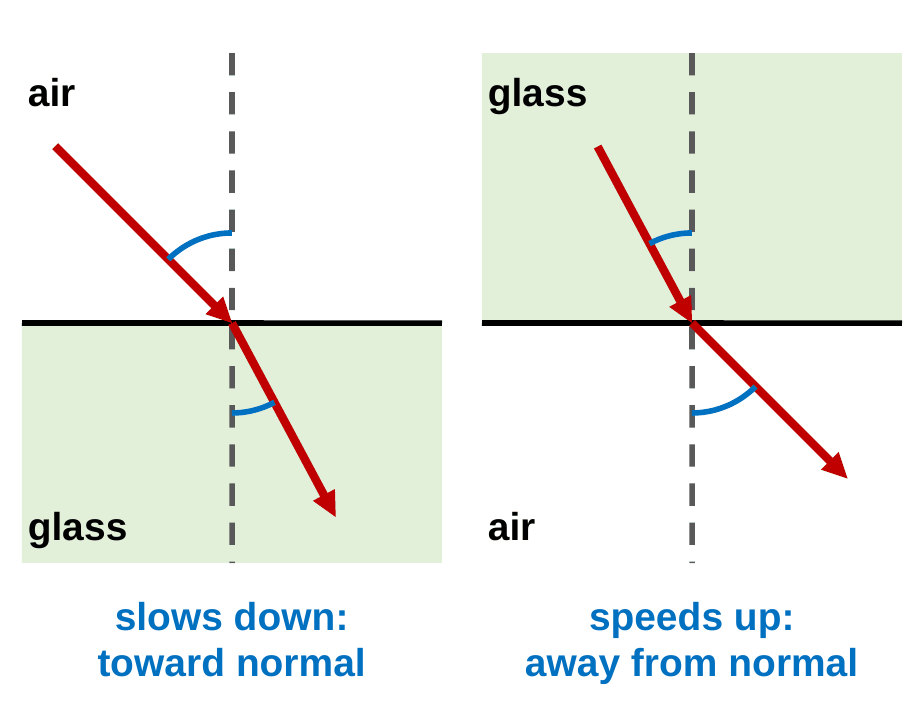
When light goes into a material where it travels slower (higher n), it bends toward the normal, so its angle gets smaller. When light goes into a material where it travels faster (lower n), it bends away from the normal, so its angle gets bigger. The path works the same in both directions: the right picture is just the left picture run backward. A ray that travels exactly along the normal changes speed but doesn’t bend.
Why Light Bends
- Wave fronts slow down in glass
- One side slows down first
- Like a wagon rolling onto grass
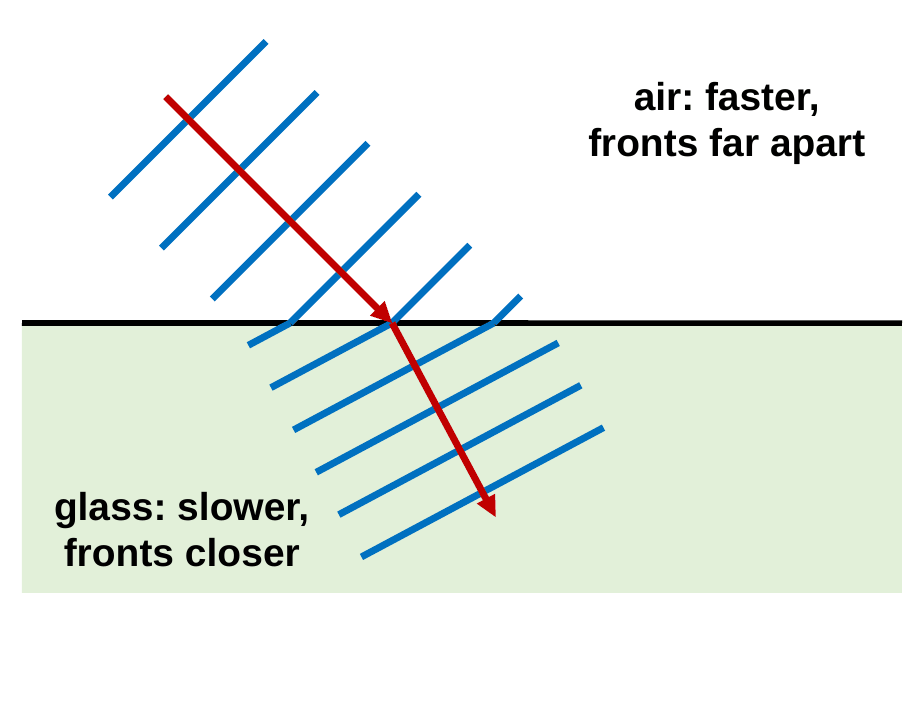
Think of light as a set of wave fronts (lines of crests) moving forward. When a wave front hits the glass at an angle, one end enters the glass first and slows down, while the other end is still moving fast in the air. That makes the wave front pivot, so the whole wave turns. It’s like rolling a wagon off a sidewalk onto grass at an angle: the wheel that hits the grass first slows down first, and the wagon turns. Notice the wave fronts are closer together in the glass. The frequency stays the same, so a slower speed means a shorter wavelength.
Snell’s Law
n1 sin θ1 = n2 sin θ2
- n1, θ1 = index and angle in the first medium (where the light starts)
- n2, θ2 = index and angle in the second medium (where the light goes)
- Both angles are measured from the normal
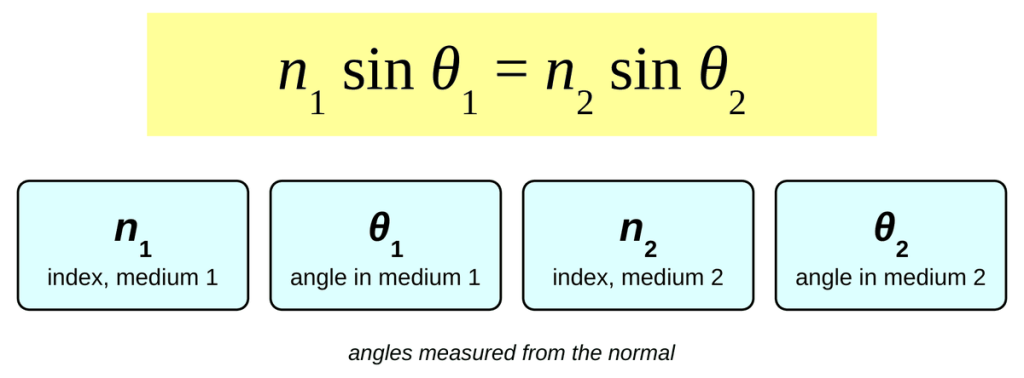
Snell’s law tells you exactly how much light bends. To find θ2, divide both sides by n2 to get sin θ2 = n1 sin θ1 / n2, then take the inverse sine (sin−1) of the result. Make sure your calculator is in degree mode.
The Bent Straw
- Light bends leaving the water
- Your brain traces rays straight back
- Underwater part looks shallower
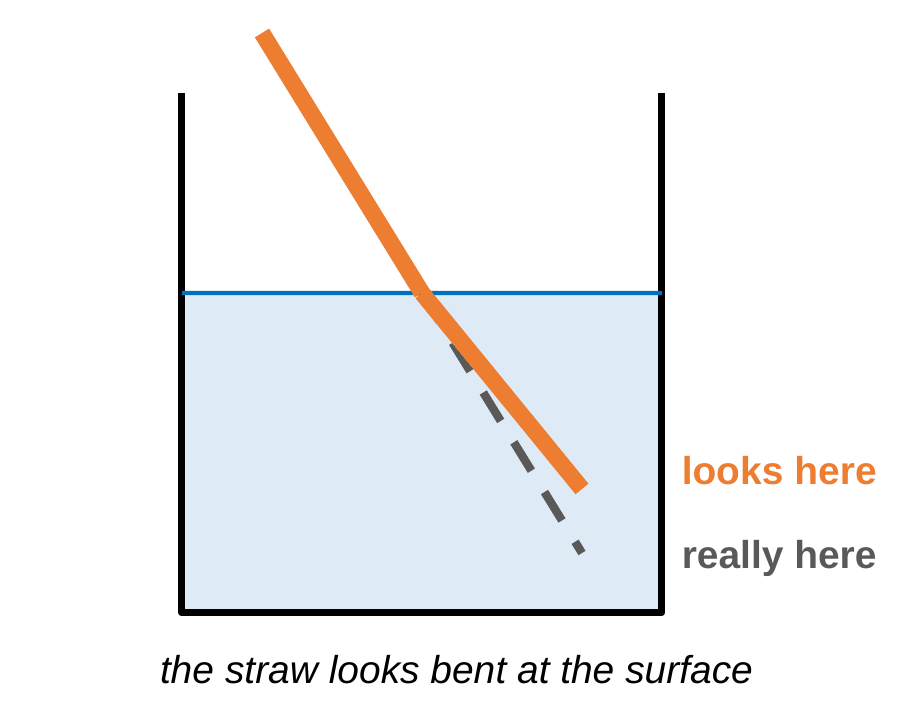
Light from the underwater part of the straw travels up through the water and into the air. At the surface it speeds up and bends away from the normal. Your brain assumes light travels in straight lines, so it traces those bent rays straight back and “sees” the underwater part of the straw higher up than it really is. The straw seems to bend right at the surface. The same effect makes pools look shallower than they are.
Worked Examples
Try each problem on your own first, then check your work against the solution.
Example 1: Light in Water
Water has an index of refraction of 1.33. How fast does light travel in water?
- Knowns: n = 1.33, c = 3.00 × 10⁸ m/s
- Equation: n = c/v, so v = c/n
- Substitute: v = (3.00 × 10⁸ m/s) / 1.33
- Answer: v = 2.26 × 10⁸ m/s
This is slower than c, as it should be, since n is greater than 1.
Example 2: Finding the Index
Light travels through a clear plastic at 2.00 × 10⁸ m/s. What is the plastic’s index of refraction?
- Knowns: v = 2.00 × 10⁸ m/s, c = 3.00 × 10⁸ m/s
- Equation: n = c/v
- Substitute: n = (3.00 × 10⁸ m/s) / (2.00 × 10⁸ m/s). The units cancel.
- Answer: n = 1.50 (no unit)
Example 3: Into Water
Light in air (n = 1.00) hits the surface of water (n = 1.33) at 40.0° from the normal. What is the angle of refraction?
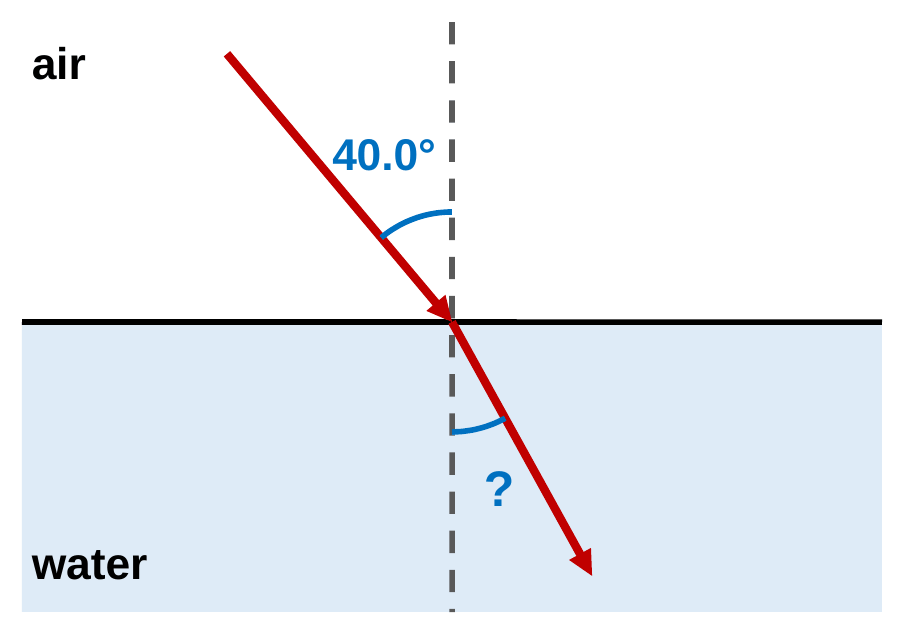
- Knowns: n1 = 1.00, θ1 = 40.0°, n2 = 1.33
- Snell’s law: n1 sin θ1 = n2 sin θ2, so sin θ2 = n1 sin θ1 / n2
- Substitute: sin θ2 = (1.00)(sin 40.0°) / 1.33 = (0.6428) / 1.33 = 0.4833
- Answer: θ2 = sin−1(0.4833) = 28.9° from the normal
Check: light slows down in water, so it should bend toward the normal. 28.9° is less than 40.0°, so it did.
Example 4: Out of Glass
Light inside a glass block (n = 1.50) hits the surface at 30.0° from the normal and passes into air (n = 1.00). What is the angle in the air?
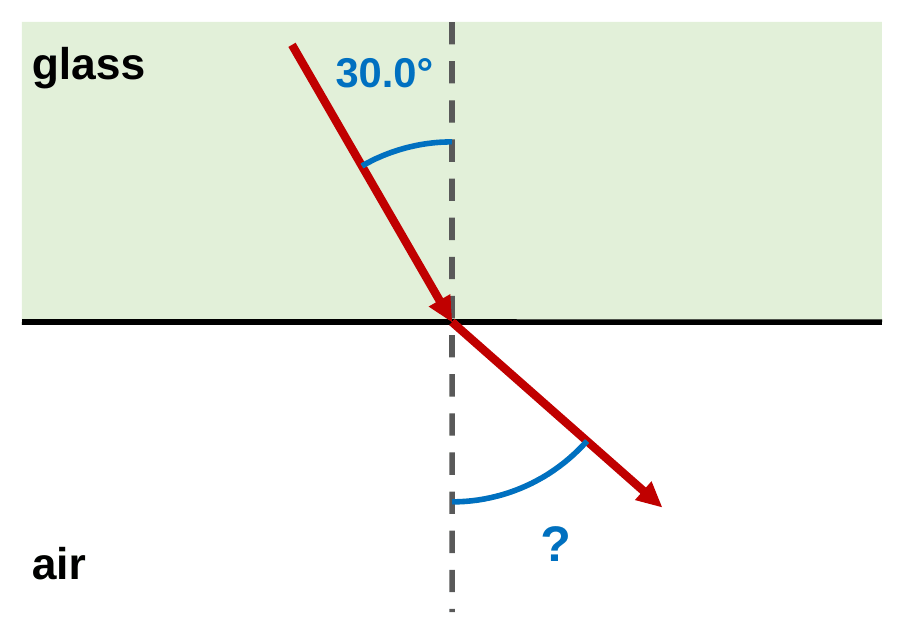
- Knowns: n1 = 1.50 (glass), θ1 = 30.0°, n2 = 1.00 (air)
- Snell’s law: sin θ2 = n1 sin θ1 / n2
- Substitute: sin θ2 = (1.50)(sin 30.0°) / 1.00 = (1.50)(0.500) / 1.00 = 0.750
- Answer: θ2 = sin−1(0.750) = 48.6° from the normal
Light speeds up as it leaves the glass, so it bends away from the normal: 48.6° is bigger than 30.0°.
Big Ideas
- Speed change at a boundary bends light
- n = c/v; bigger n, slower light
- Slower: toward normal. Faster: away
- n1 sin θ1 = n2 sin θ2
Back to the essential question: light from the underwater part of the straw speeds up and bends away from the normal as it leaves the water. Your brain traces the bent rays straight back, so that part of the straw appears in the wrong place and the straw looks bent. Snell’s law, n1 sin θ1 = n2 sin θ2, tells us exactly how much light bends. Next up, we’ll see that light sometimes acts like a particle in The Photoelectric Effect.

