
The video lesson for this topic is coming soon.
Essential Question
What do radio waves, light, and X-rays have in common?
Radio waves play music in your car, visible light lets you see, and X-rays show the bones in your hand. By the end of this lesson, you should be able to put the electromagnetic spectrum in order, connect wavelength, frequency, and energy, and use c = fλ.
What Is an EM Wave?
- Electric + magnetic fields
- Each field creates the other
- No medium needed
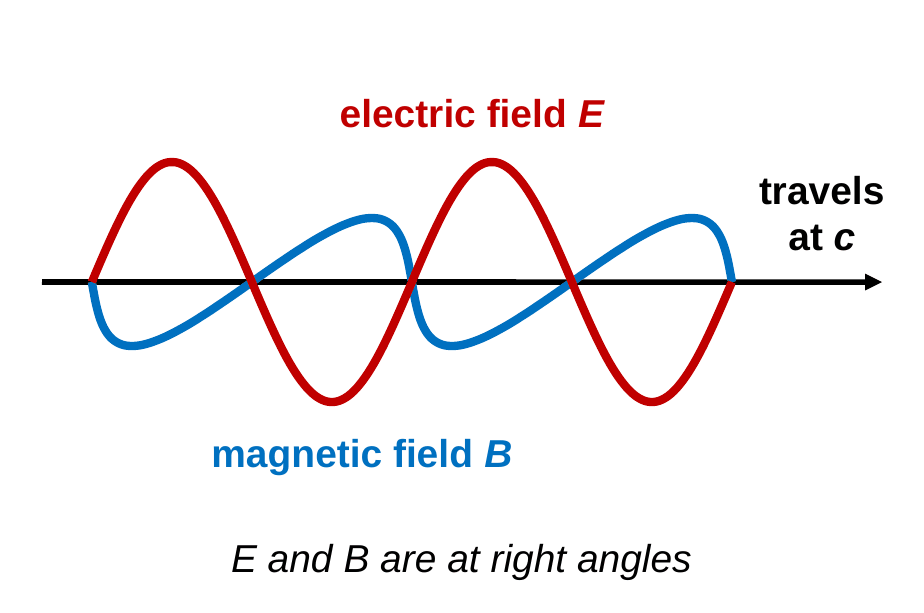
An electromagnetic (EM) wave is made of a changing electric field and a changing magnetic field. A changing electric field creates a magnetic field, and a changing magnetic field creates an electric field, so the two keep each other going as the wave travels. Because the wave is made of fields, not matter, it needs no medium and can cross empty space. The two fields are at right angles to each other and to the direction of travel, so EM waves are transverse.
The Speed of Light
c = 3.00 × 10⁸ m/s and c = f λ
- Same speed for all EM waves
- Called c, the speed of light
- Sun to Earth: about 8 minutes
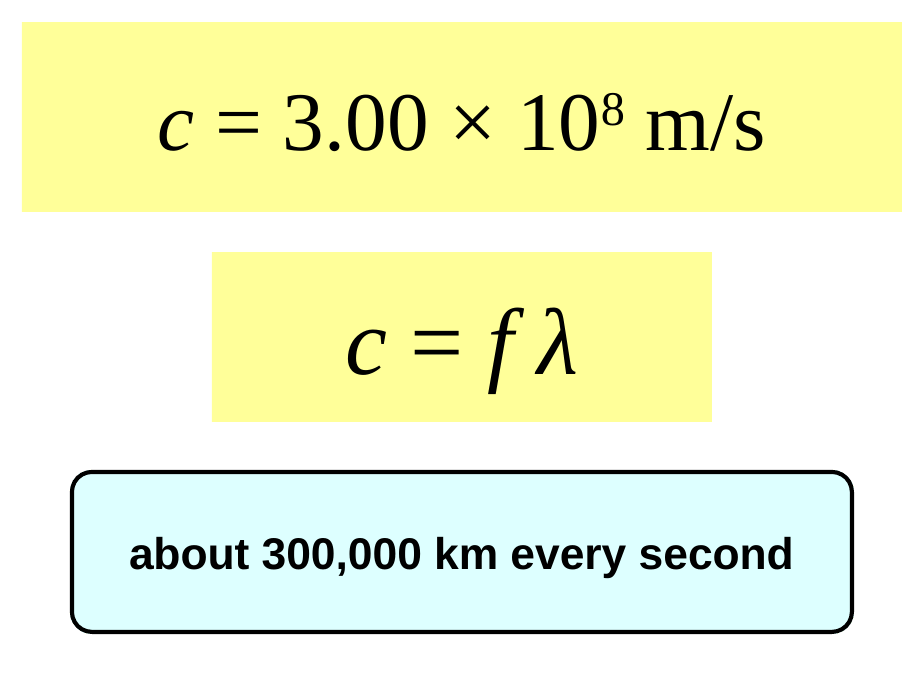
Every EM wave, from radio to gamma rays, travels through a vacuum at the same speed, the speed of light, c = 3.00 × 10⁸ m/s. That’s about 300,000 km every second, fast enough that sunlight crosses 150 million km to Earth in about 8 minutes. Since every EM wave has the same speed, the wave equation becomes c = fλ.
The EM Spectrum
From longest wavelength to shortest: radio, microwave, infrared, visible, ultraviolet, X-ray, gamma.
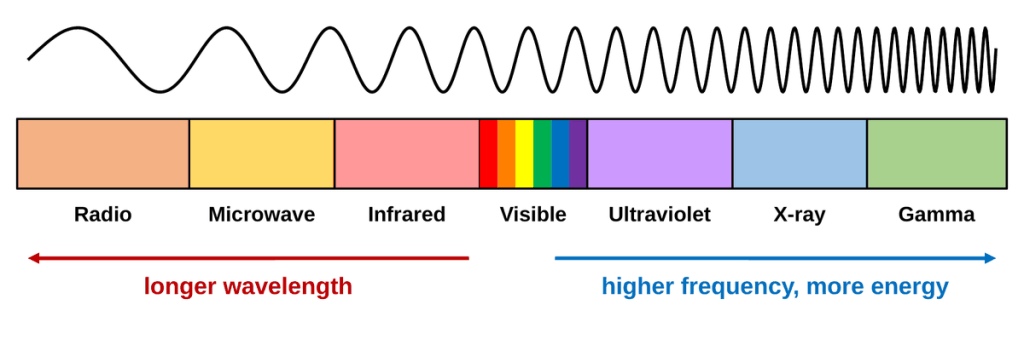
All of these are the same kind of wave. They differ only in wavelength and frequency. Radio waves can be longer than a building, while gamma rays are smaller than an atom. Moving from left to right, wavelength gets shorter, and frequency and energy get higher. Visible light, the only part our eyes can detect, is a thin slice in the middle.
Visible Light
- A tiny slice of the spectrum
- Red: longest λ, about 700 nm
- Violet: shortest λ, about 400 nm
- 1 nm = 10−9 m
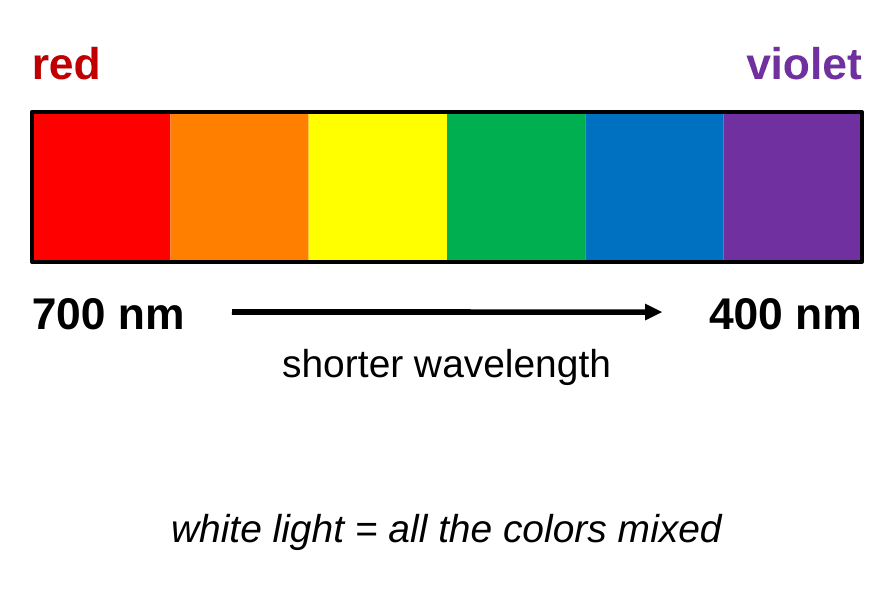
Visible light is the small part of the EM spectrum our eyes can detect. Its wavelengths run from about 700 nm (red) down to about 400 nm (violet), where 1 nm (nanometer) is 10−9 m. Each color is a different wavelength. White light, like sunlight, is all of the colors mixed together, which is why a prism or raindrops can spread sunlight into a rainbow.
Wavelength, Frequency, and Energy
- All travel at the same speed c
- Shorter λ: higher f
- Higher f: more energy
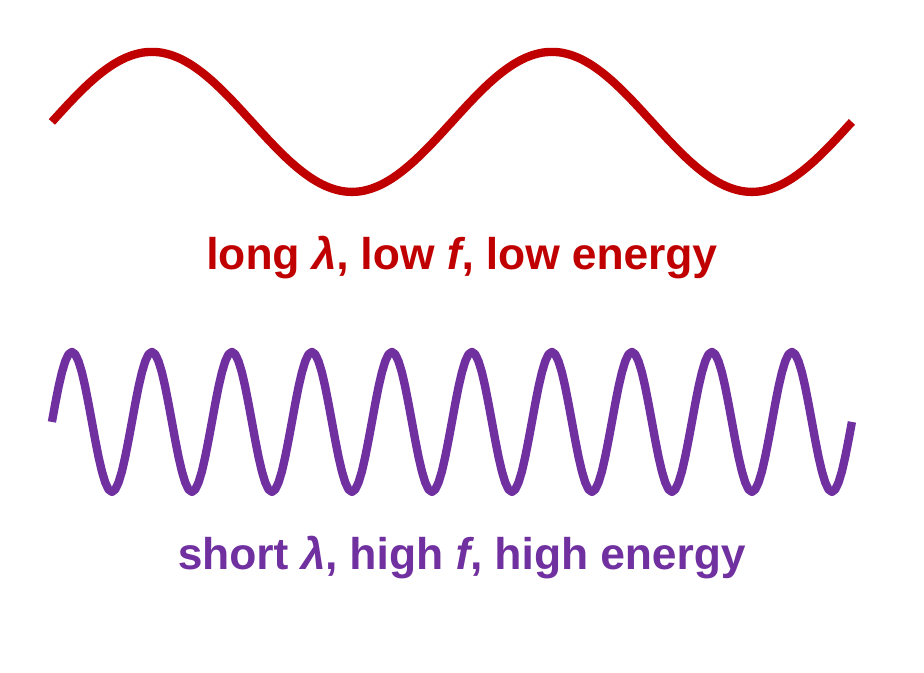
Since every EM wave travels at the same speed c, and c = fλ, wavelength and frequency are inversely related. If the wavelength is shorter, the frequency must be higher to keep the product equal to c. Higher frequency EM waves also carry more energy. That’s why ultraviolet light can give you a sunburn but radio waves pass harmlessly through you.
EM Waves and Living Things
- Longer λ: absorbed as heat
- UV, X-ray, gamma: ionizing
- Ionizing waves damage cells
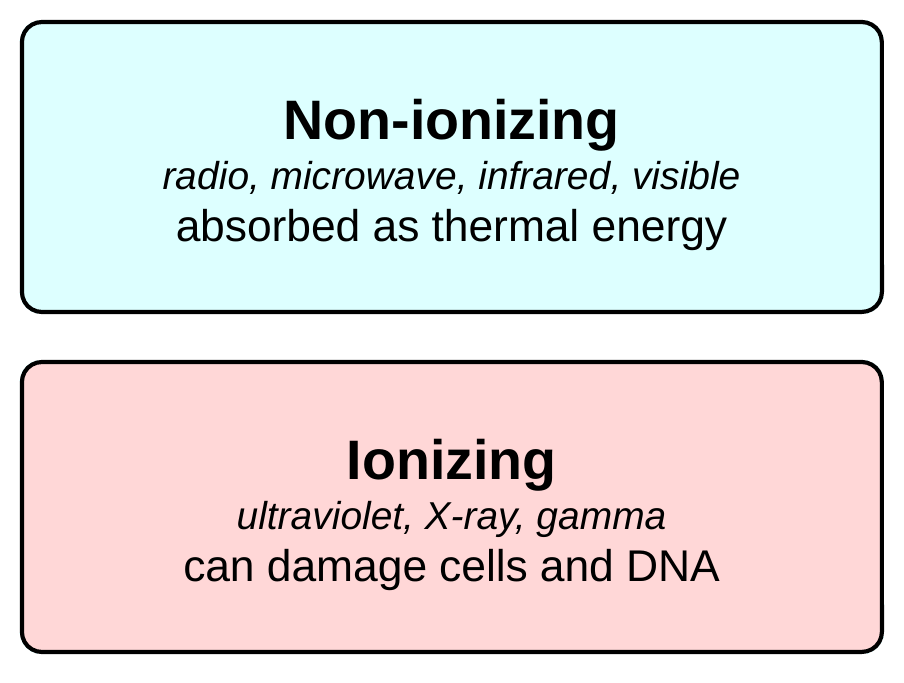
When your body absorbs longer wavelength EM waves, like microwaves and infrared, the energy mostly becomes thermal energy. It warms things up, which is how a microwave oven heats food and why sunlight feels warm. Ultraviolet, X-rays, and gamma rays have enough energy per wave to knock electrons out of atoms. This is called ionizing radiation, and it can damage cells and DNA. That’s why we use sunscreen and why X-ray technicians step out of the room.
Worked Examples
Try each problem on your own first, then check your work against the solution.
Example 1: FM Radio
An FM radio station broadcasts at a frequency of 1.00 × 10⁸ Hz. What is the wavelength of its radio waves?
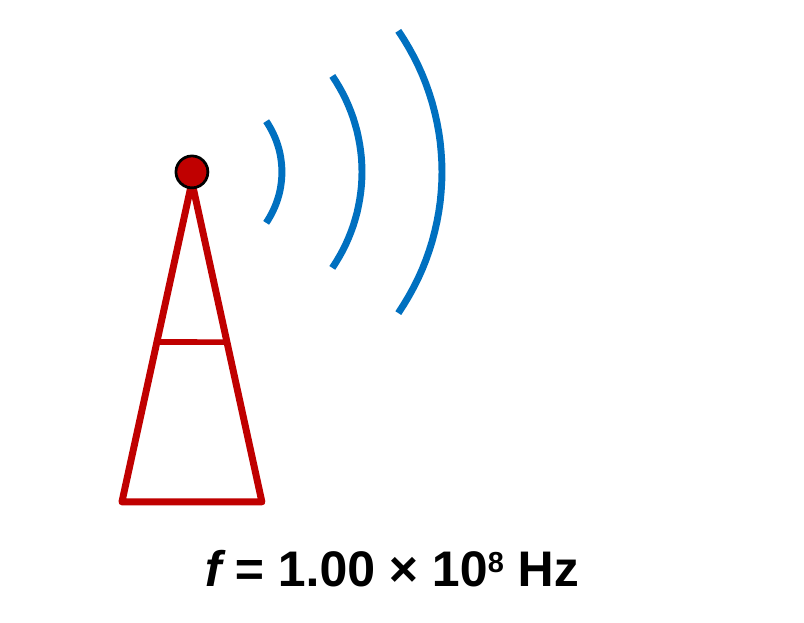
- Knowns: f = 1.00 × 10⁸ Hz, c = 3.00 × 10⁸ m/s
- Equation: c = fλ, so λ = c/f
- Substitute: λ = (3.00 × 10⁸ m/s) / (1.00 × 10⁸ Hz)
- Answer: λ = 3.00 m
That’s about as long as a car. Radio wavelengths are big.
Example 2: Microwave Oven
A microwave oven heats food with microwaves at a frequency of 2.45 × 10⁹ Hz. What is their wavelength?
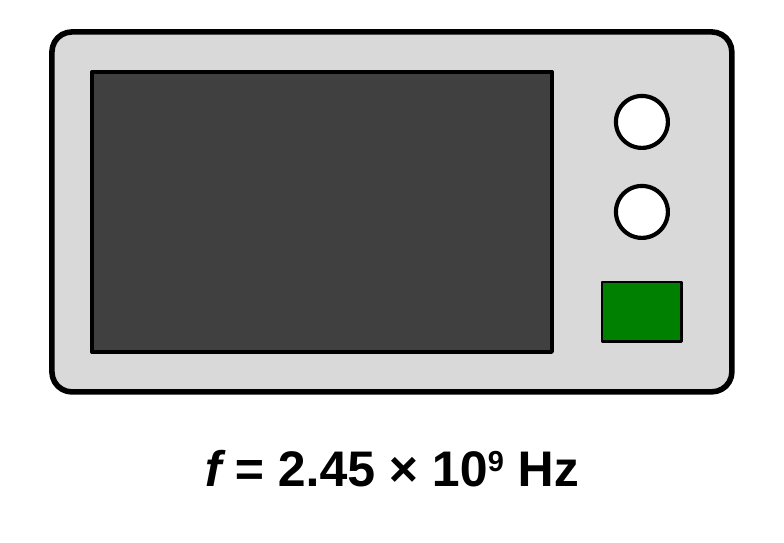
- Knowns: f = 2.45 × 10⁹ Hz, c = 3.00 × 10⁸ m/s
- Equation: λ = c/f
- Substitute: λ = (3.00 × 10⁸ m/s) / (2.45 × 10⁹ Hz) = 0.1224… m
- Answer: λ = 0.122 m (about 12 cm)
Example 3: Green Light
Green light has a wavelength of 5.00 × 10⁻⁷ m (500. nm). What is its frequency?
- Knowns: λ = 5.00 × 10⁻⁷ m, c = 3.00 × 10⁸ m/s
- Equation: c = fλ, so f = c/λ
- Substitute: f = (3.00 × 10⁸ m/s) / (5.00 × 10⁻⁷ m). Meters cancel, leaving 1/s = Hz.
- Answer: f = 6.00 × 10¹⁴ Hz
Example 4: Ranking EM Waves
Rank radio waves, visible light, and X-rays from lowest to highest frequency. Which one can damage cells? Which travels fastest in a vacuum?
- Use the spectrum order: radio, microwave, infrared, visible, ultraviolet, X-ray, gamma (lowest to highest frequency)
- Rank: radio < visible < X-ray
- Damage: X-rays are ionizing, so they can damage cells
- Speed: all three travel at the same speed, c = 3.00 × 10⁸ m/s
Big Ideas
- EM waves: electric + magnetic fields
- All travel at c = 3.00 × 10⁸ m/s
- Radio, micro, IR, visible, UV, X-ray, gamma
- Shorter λ: higher f, more energy
Back to the essential question: radio waves, light, and X-rays are all electromagnetic waves: changing electric and magnetic fields that travel through empty space at c = 3.00 × 10⁸ m/s. They differ only in wavelength and frequency, and higher frequency means more energy. Next up, we’ll see how light bounces off surfaces in Reflection and Mirrors.

